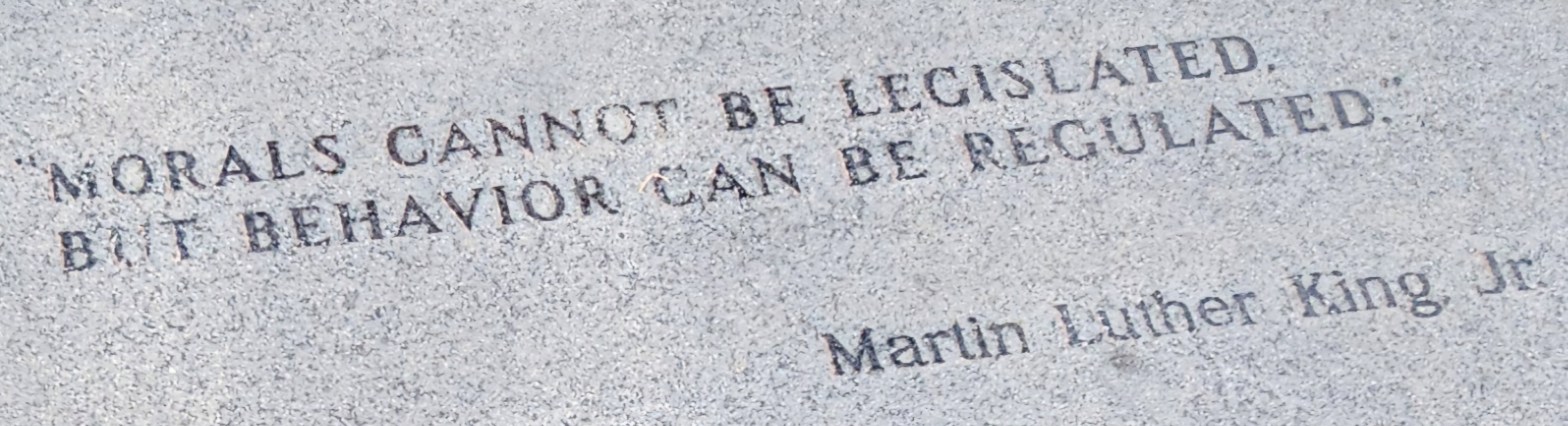
Great things often are set in stone. One of them is a Martin Luther King, Jr. quotation. It may best explain the Ten Commandments’ secular value. While recently in San Diego, I came upon it in a park filled with his quotations.
“Morals cannot be legislated but behavior can be regulated,” he declared.
This quote can be interpreted on a multitude of levels. It implies that legislation can be devoid of morals. Thus, a law can fail to address the question of whether action or prohibition is “right or wrong.” That particular notion is the purview of morals.
The Ten Commandments’ innovation was melding morality into the law. Thus, viewing the Decalogue on a Secular basis, one should appreciate that the commandments achieved something that legislation cannot. Martin Luther King Jr. appreciated that there was a need for a society to know what is right from wrong. If not through legislation, how can that be achieved?
The Ten Commandments’ success is its vagueness. Certain Commandments inspire creativity. They ask people to think about their behavior. People start asking questions: How should the Sabbath- a day of rest- be shared with others? How can one honor their parents? How can one find happiness when seeing others who have more?
Conclusion
In essence, the Commandments open the door for societal members to have a moral mindset. The Decalogue inspires people to always thinking about their surroundings. How can we do things right? How can we do things that are positive or constructive? While these notions can be viewed from a religious context, they also have secular value, applications, and utility.
Be well!!
Please like, follow, share or comment.
 The Ten Commandments Project
One thought on “Ten Commandments’ Secularity Best Explained?”