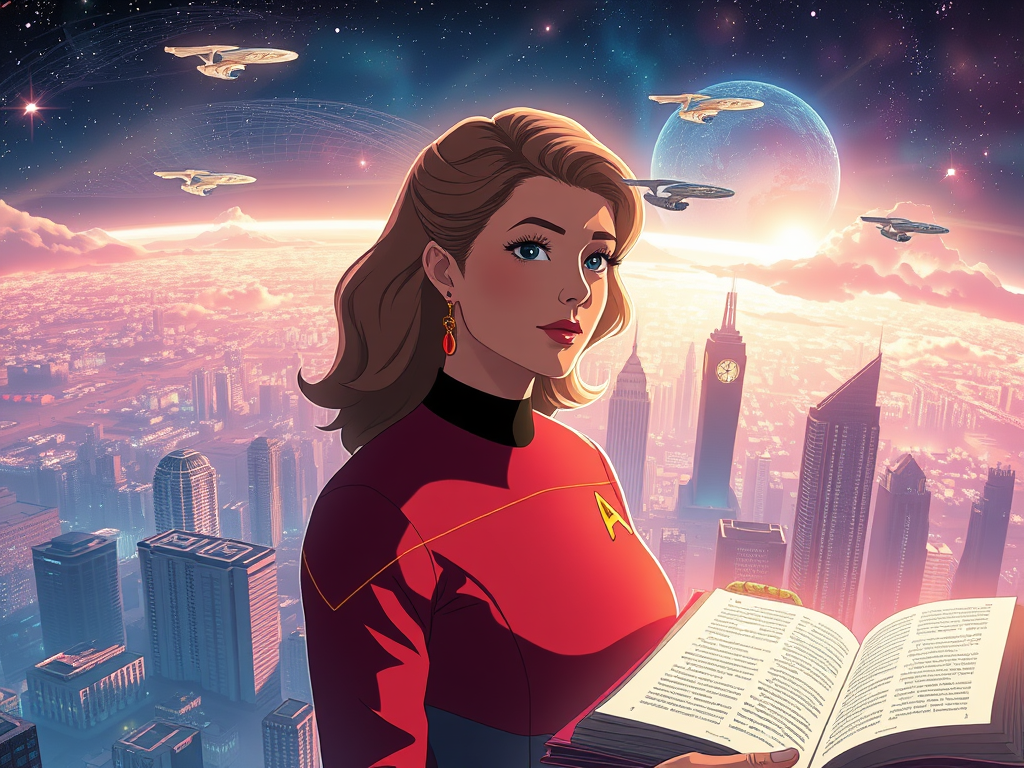
It wasn’t on my bingo card, but it happened. Unforeseen circumstances led to a close encounter with the Trek-world. Sadly, it was to occur at a life celebration. My invite to the event included the enticement of: “the lady from Star Trek” was going to be there. Who could it be?
When I showed up, I was pleasantly surprised. It was a true Star Trek star. Marina Sirtis- Counselor Deanna Troi from the Next Generation series- was there. I spent the evening with her and her husband.
As a long-time Angeleno, I have a celebrity engagement rule. I act as if I don’t know about their fame. This often yields to great conversation. Rather than learning about the famous five-year mission to explore strange new worlds, I got something far different. Ms. Sirtis graciously provided me cooking tips. To date, they are golden.
Had I been blogging at the time, I perhaps would have made a deep query on an interesting topic. In a remarkable show scene, her character expressed part of Gene Roddenberry’s vision of the future. Given that Star Trek has truly influenced the world, his innovative thoughts for the landmark second series warrants discussion.
The expression took place in a time travel episode. Counselor Troi engaged in conversation with the American Author Mark Twain. Mr. Twain pondering as to whether his present was better than the future that he was experiencing. In describing the future to Mr. Twain, she noted that “Poverty was eliminated on Earth, a long time ago. And a lot of other things disappeared with it – hopelessness, despair, cruelty…” Time’s Arrow, Part 2.
This world vision, however, conflicts with what as the Torah’s future vision. Scripture has a rather stark view of what was to be the future. Deuteronomy 15:11, notes: “Because there won’t stop being an indigent in the land. On account of this I command you, saying: you shall open your hand to your brother, to your poor, and to your indigent in your land.”
The Debate
Which one is correct? The scripture’s track record is over two thousand plus years ago of being accurate. There are still people in need. As such, mandated concern for those in need is required.
What can be said about the Star Trek vision? The world has not technologically developed sufficiently to realize Star Trek’s vision. While we developed space craft, including one Star Trek inspired called Enterprise, we have not afforded other Trek-like technology.
While the world is progressing with innovations such as 3-D printing, there is much more innovation coming. There were additional technologies which could be employed to eliminate poverty. Could concepts aligning with warp speed travel, transporters and food replicators become reality? Is it possible that they would be able to remediate life’s unfortunate downside?
Assuming that poverty is eliminated, one must also wonder as to whether there would be unforeseen consequences? Could poverty’s elimination negatively impact human-human interaction?
Or, is it likely that the the Torah’s vision is truly timeless? Is it that this certainty to mandate care and concern for the less fortunate an integral part of humanity?
Conclusion
Only time will truly determine whether a Star Trek vision is realized. One must appreciate that the actual elimination of poverty could negatively impact the quality of human interaction. The human capacity to be compassionate to others may be severely diminished if others have no needs. Would the mindset of helping those in need be eliminated? Could a utopian vision lead to something quite problematic?
Be well!!
Please like, follow, share or comment
 The Ten Commandments Project
2 thoughts on “Past Vision vs. Future Vision”