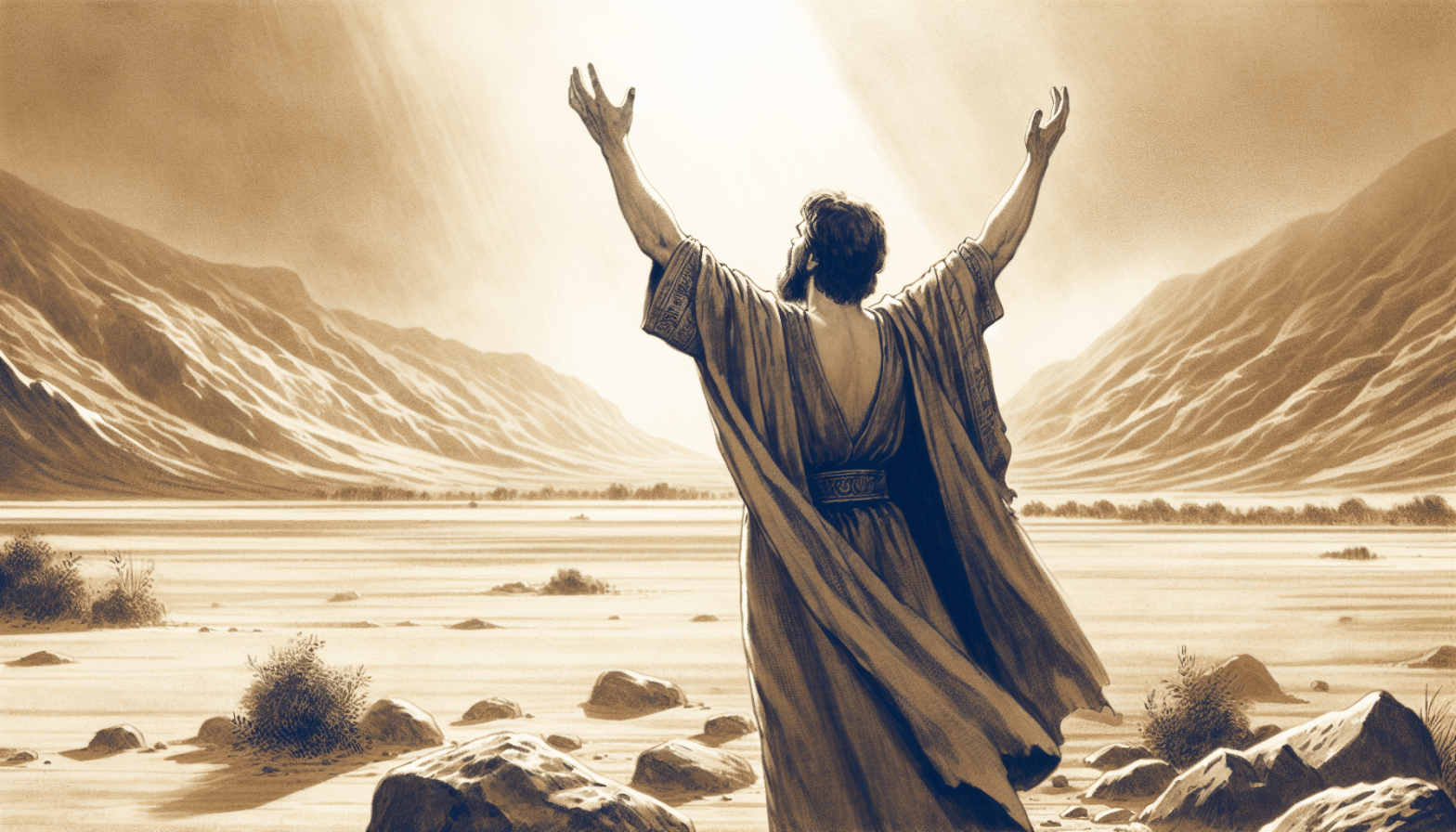
If the Hebrew Bible was being crafted as a movie script, half-way through the screen play of the Book of Kings an emergency writers’ meeting would have taken place. “Writers, we have a problem!”
The Lead Writer would bemoan that the fledgling spin-off Northern Kingdom- Israel- was lacking. No intriguing characters! No cool locations! No cool props! The Lead would complain that this kingdom was the woeful little brother to its Judean big brother.
“How can we make this interesting when their big brother had all the great stuff? The Temple with the Ark of the Covenant. Israel, on the other hand, thanks to Jeroboam, Israel has to offer up two graven images of two bulls – the so-called “Gods of Israel.”
As far as personalities, the big brother nation claimed the likes of the Prophets Samuel and Nathan; and the Kings David and Solomon. Israel- with its Ten Tribes- on the other hand, had no one super special.
The Lead Writer would have asked, “What type of character could be blow up this script?” These writers would have worked hard and would have come up with a most epic figure. A Moses-like figure. How about Elijah the Prophet?
Elijah is the Israelite nation’s game changer. His exploits ended up so amazing that a sequel was made. Elijah mysteriously emerges onto the scene. His arching story- as deep as a Simon & Garfunkel song- will have him become the Northern Kingdom’s eternal character. His zealousness will arguably reunite the Twelve Tribes.
Despite the Israelite Kingdom’s success with the Omiride Dynasty, its moral standing, in the eyes of the Lord, was lacking. The Prophet Elijah emerges on to the scene to throw “cold water” on their passion towards idolatry. He confronts their successful King Ahab and declares a drought.
From the onset, Elijah’s Moses-Connection is apparent. His initial action reeks similarity to Moses’ confrontation of Pharoah. Moses’ objective, was to reconnect the Children of Israel their God. This will also be the case with Elijah.
Elijah-the “no rain man”-flees from Ahab akin to Moses’ fleeing Egypt after killing the task master. Elijah, during his period of flight, is nourished by an ancient food delivery service of ravens. Take that Grubhub! Commanded by the Lord, they deliver food from the sky akin to Moses’ receipt of mannah from heaven for the Children of Israel.
In Elijah’s flight, he takes shelter from a widow and her son. While there, he assists the woman for her kindness with abundant food. He, as well, revives her son. After this miracle, the woman declares that he is truly “a man of God.” Moses, after fleeing Egypt, took up with Jethro, and his daughters. He assists them and becomes part of their family. While with them, he has his first Mt. Sinai moment upon which he is told by the Lord that he is going to be God’s emissary.
Elijah returns to Israel. There, he has a showdown with the Prophets of both Baal and the Asherah-tree. This match certainly bears liking to Moses’ confrontation with Pharoah’s neromancers in connection with the Ten Plagues.
For Elijah, Israel’s fate will be decided by two bulls. Not the graven images that Jeroaboam commissioned, but rather real live bulls set for sacrifice. This two-bull challenge is to whose sacrifice will be received by their respective God. This event is reminder to Moses’ Golden Calf. In this contest, Elijah confronts the Israelites as to this test and they accept that whichever God responds with fire is the true God. This moment certainly connects to the Children of Israel’s acceptance of the Ten Commandments via Moses. In the challenge’s preparation, Elijah rebuilds the God of Israel’s altar with twelve stones. Similarly, Moses picked up the broken commandments and replaced them with a new set.
In summoning the fire to win the contest against the idolator prophets, Elijah addresses the Lord, God of Abraham, Isaac and Jacob. Both the Tetragrammaton as well as the generational name is elicited. With Moses, when he queried the Lord concerning the deity’s name, the Lord provided those names at the Burning Bush.
With Elijah’s success in delivering the sacrifical fire from the Master, Jezebel’s prophets are prompty slaughtered. This purge similar to Moses’ actions following the Golden Calf incident. With this, Elijah makes it rain. He succeeds in reaching King Ahab. With Moses, Pharoah finally concedes to release the Hebrews. Moses after the leaving Egypt, however, is quickly confronted with Pharoah changing his mind. Likewise, Elijah’s success was shortlived as Jezebel turns King Ahab’s opinion of Elijah negatively and he becomes a wanted man.
Elijah, in fleeing, has an encounter at Mt. Sinai. His journey there was 40 days and 40 nights. Moses, of course, has multiple Mt. Sinai encounters involving 40 days and nights. Elijah’s Mt. Sinai moment is one of frustration. He is asked by the Lord, “why are you here?” He replies, “I have acted with great zeal for the Lord, God of Legions, for the Children of Israel have forsaken your covenant; they have razed you altars and killed your prophets by the sword, so [that] I alone have remained, and they now seek to take my life.” Perhaps, in all the noise- the violent wind, earthquaking, and fire, Elijah cannot see that he won. Perhaps, the Lord was trying to help him understand this by noting that in silence- perspective- he made remarkable achievements. For Moses, his initial Mt. Sinai encounter was one of doubt. He was not a believer in himself.
With Elijah, the Lord appreciates the cost of zealousness. Elijah is instructed to utilize others to further carry out God’s plan: Hazael, Jehu are to be annointed kings by Elijah and Elisha will take over his role as prophet. Seven Thousand Israelites will remain. Those who did not entertain Baal with either kneeling or kissing. With Moses, he had Aaron to assist with Joshua to follow. Likewise, with the Golden Calf incident, there was an uprooting within the population of the Children of Israel.
At this point, the Writer’s meeting ended with the writers exhausted. The Lead Writer said, “this is great material! Perhaps, we can get a sequel!”
This foolish writing exercise is revealing. The Israelites’ trajectory was in desparate need for a figure who could transform. Elijah the Prophet filled a need. He was the Moses of Israel. He was a Moses who was in a world in which the commandments had already been delivered to the people. He was challenged with addressing people who, at the moment, were likely incapable of digesting the commandments. Thus, he was the one who stood on a mountain and revived the monothesitic message of the Ten Commandments. The belief in the God of Israel was revived in front of the entire Northern Kingdom of Israel. His zealousness elevated him as the Major Prophet of Israel. Not only did he elevate the Northern Kingdom’s religiousity, he connected to all tribes. He did so by respecting the notion that the twelve tribes superceded the two kingdoms. His placing of twelve stones on God’s altar evidenced him as a unifier.
Could there be a sequel?
Be well!!
Please like, follow, comment or share.
 The Ten Commandments Project