At Mt. Sinai, while the Decalogue was delivered to the Children of Israel, there neither king annointed or the coronation of one. Rather, the holy mountain experience was a deity covenanting with his nation.
The Israelites understood, as was written in stone, that their particular relationship was with a “jealous” God. Exodus 20:5. Thus, the well-being of this marriage was tied to the nation’s fidelity.
Before the Decalogue’s deliverance, the Lord provided some conditions to the marriage: “and now, if you’ll listen to my voice and observe my covenant, then you’ll be a treasure to me out of all of the peoples, because all of the earth is mine. And you’ll be a kingdom of priests and a holy nation to me.” Exodus 19:5-6.
As Commentator Richard Elliott Friedman explained, the rationale was that they “would be a blessing to all of the families of the earth” in accordance with the Lord’s covenant with Abraham. [Note: The covenant’s cost should be appreciated. It included the requirement to both listen to and observe the rules. Thus, learning and Torah observance was existential to the nation. Being a treasure brought with it a burden.]
While the Ten Commandments’ framework did not include a mortal king, the Israelites chose to live subject to a monarchy.
After the reign of King Solomon, however, the Israelites divided into two kingdoms- the Northern and the Southern.
In the Southern Kingdom, during Solomon’s reign, the Temple was built. During the Assyrian conquest, however, both nations fell and the Temple was destroyed.
Assyria was eventually conquered by Persia. The Persian Empire permitted some Israelites to return to their homeland; a land with neither a Temple or King.
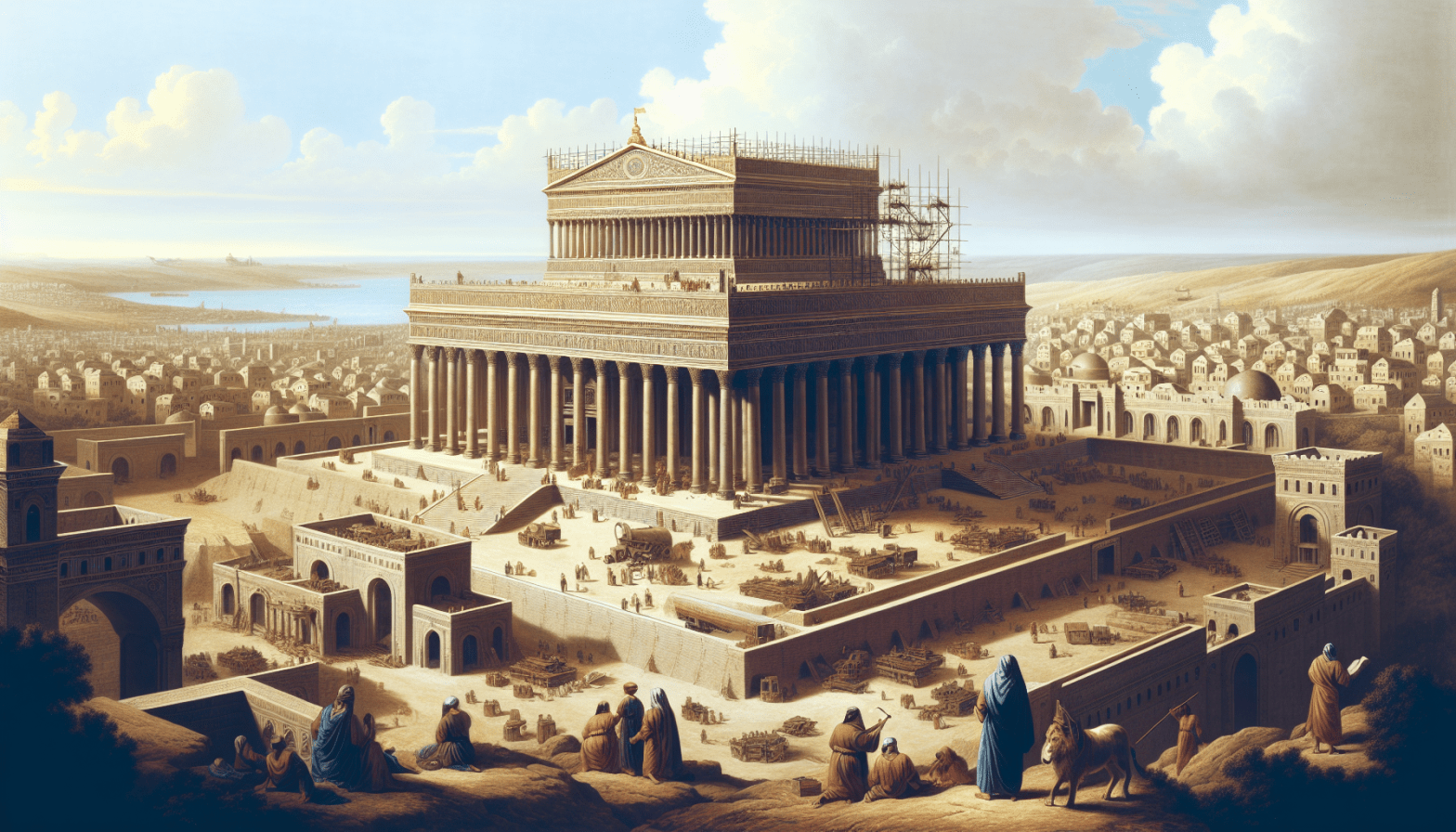
The Prophet Haggai, who was in the Promised Land during the second year of King Darius-a Persian ruler, declared: “Thus said the Lord, Master of Legions, saying ‘This nation has said, ‘the time has not yet come! [But I say] It is time for the Temple of the Lord to be rebuilt.'” Haggai 1:2.
With this pronouncement, it is contended that the “old” Mt. Sinai relationship became anew. The people, rather than a monarch, would be re-building the Temple. In this moment, arguably, the deity’s relationship with the Children of Israel returned to that was formed at Mt. Sinai.
Admittedly, however, was some political structure in the Promised Land. Zerubbabel was the Judea’s Governor. The Prophet Haggai reports that the Lord aroused those involved with the Temple building project with spirit. This included with Governor, the Kohen Gadol- the high priest, and “the remnant of the people, and they can and did work on the Temple of the Lord.” Haggai 1:14
The scripture supports the assertion that what occurred was the re-connection to Mt. Sinai’s covenant. Speaking the Lord’s words, the Prophet alludes to “the matter [of the covenant] that I sealed with you when you went forth from Egypt.” Haggai further conveys the Lord’s message: “My spirit remains in your midst; do not be afraid.” Haggai 2:5
Thus, at that moment, the “new” relationship set forward to re-build the Temple was of the old. It reunified the Lord to his nation sans monarchy. No monarchy was required to rebuild the People’s spirit. Professor Jacob Wright, author of “Why The Bible Began” perhaps would indicate that the Second Temple was the People’s Temple to the Lord.
In sum, the Prophet Haggai’s words represent a unique Ten Commandments’ moment; an instance in which there was a return to the Mt. Sinai vision. While one may argue that the notion of a return to monarchy was still being contemplated, Haggai’s text does not explicitly advance that notion. Rather, Prophet’s words, however, suggest that this building project perhaps represented a return to the intimacy of the original national covenant.
Be well!!
Please like, follow, share or comment
Question: After Mt. Sinai, there was something special that occurred that further proves this assertion. What was it?
 The Ten Commandments Project