For Hebrew Bible lovers, Richard Elliott Friedman’s Who Wrote The Bible and Jacob Wright’s Why the Bible Began: An Alternative History of Scripture and Its Origins are popular reads.
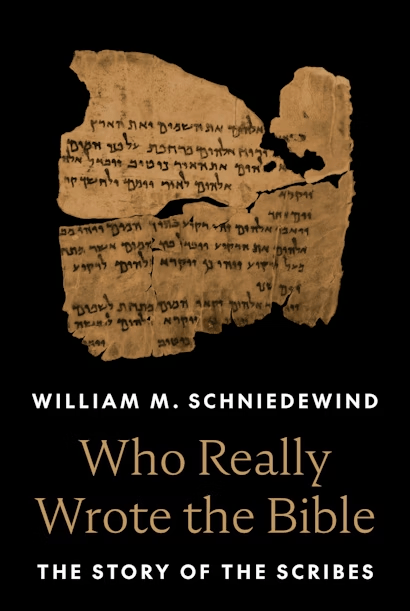
While both scholars- in both text and interviews- speak of scribes’ role in the Bible’s development, they do not elaborate too much on these mostly unknown individuals. Thus, Who Really Wrote the Bible by Prof. William M. Schniedewind, Professor of Biblical Studies & NWS Languages Director of Graduate Studies, NELC Department, Sady and Ludwig Kahn Director | Alan D. Leve Center for Jewish Studies, fills in the gap and provides scholarship on the scribes. His text provides important insights into these individuals.
While this blog already did a review, Professor Schneidewind graciously answered questions on his book and scholarship.
What has been the reception of this book?
It’s a bit early, no major reviews yet, but it seems to be selling well. It’s gotten book notes from various sources that Princeton has highlighted on their website. “Insightful and enjoyable. . . . Schniedewind’s erudite but still conversational prose brings admirable clarity to ancient breadcrumb trails of evidence. It’s an enlightening deep dive into the social world in which the Bible was written.”—Publishers Weekly “[An] illuminating book.”—Library Journal “An important work in academic biblical studies.”—David Tesler, AJL Reviews “An important corrective to the tendency to impose contemporary notions of lone authorship onto these ancient texts.”—Choice I will meet with my publisher from Princeton next week, mostly to talk about my next book. But I should get some more insight from the publisher’s perspective.
In writing your book, what was your sense of the scribal community interactions? Collaborative, competition…?
I think there were both collaborative and competitive aspects. For example, the Jerusalem Temple priests and priests at peripheral shrines like Shiloh (e.g., Jeremiah) had very different perspectives. On the other hand, there are shared parts of scribal curriculum and learning that can be seen in the literature and technical aspects of writing (e.g., spelling, word choice, paleography/script, literary allusions).
In writing your book, was there any uniqueness to the Judean scribal community in comparison to Mesopotamian and Egyptian scribal communities?
Mesopotamia and Egyptian were major civilizations with centuries and centuries of scribal tradition and learning. Judah was a relative backwater by comparison — it was the Appalacia of the ancient near east. Egypt and Assyria were like New York and San Francisco, and Judah was like Boise or Fresno. Orders of magnitude different as economies and societies and social connections. Jerusalem was a landlocked small town in the central hills, whereas Egyptian and Mesopotamian scribal cultures were in major cities with centuries of history and at the crossroads of civilization. (Actually, it is a contrast that I reflected upon in my earlier book, How the Bible Became a Book: the Textualization of Ancient Israel [Cambridge University Press, 2004]. Why should literature have arisen at all in such a place as Jerusalem? But it did!
In Jeremiah, there is talk of writing up a deed for a land purchase, what was your impression of the scribal life? What roles did they have to make a living?
Different professions made a living in different ways. There were the professionals that worked for the government (accountants, administrators, advisors/prophets). Then there were the priests in Jerusalem that had the major temple economy and oversight of rituals to manage. Rural priests (like Jeremiah) had to use writing in a more diversified manner because they weren’t managing a major temple economy. Then there were people who were merchants that used writing in a more utilitarian way.
Any new projects to look forward to?
New book I’m working on is tentatively titled, Locating God: the Historical Struggle of Israelite Religion. It’s essentially a history of Israelite religion. I also just finished a draft of a commentary on the Book of Chronicles for Cambridge University Press. I tried to emphasize the perspective of the Persian audience, that is, the post-exilic community for whom the book would have been composed.
Note: Professor Schniedewind’s work provides insight as to how different versions of the Hebrew Bible came into existence. He expressed astonishment as to the fact a location outside of two major civilizations generated the text. This notion is amplified by the fact that the Israelite scribal community was diverse and not centralized. Thus, it is quite possible that competing versions of the same scripture existed. One of the most important examples of this comes with the Septuagint. The Bible’s first foreign language translation indicates that it was working off of a text different from the Masoretic Text. It would certainly be a great discovery as to how consensus was reached (and not reached) to the text.
Be well!!
Please like, follow, comment and share.
 The Ten Commandments Project
One thought on “Who Actually Wrote the Bible? Questions and Answers From Prof. William M. Schniedewind”