
May you live in interesting times
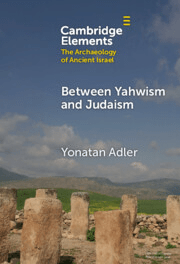
Author Yonatan Adler’s prequel to his Origins of Judaism entitled Between Yahwism and Judaism explores a pre-Judaistic period. His new book examines the period immediately prior to the emergence of widespread Torah adherence in antiquity.
In Origins, Professor Adler opined that the Levant’s popular Torah practice began during the Hasmonean Dynasty- 104 to 37 BCE. Thus, Between Yahwism, tackles the archaeological record preceding the Maccabees- the Early Hellenistic period, 332–167 BCE.
The Hasmonean Dynasty was historically dynamic time. The Maccabean revolt, the creation of an independent Jewish state, and the Jerusalem Temple’s re-dedication. 1 Maccabees, 4:41-51, are some of the highlights.
The Survey
The term Yahwism refers to the ancient Israelite practice of worshiping Yahweh. This term Yahweh refers to the name of God. In Between Yahwism, Professor Adler explores this Early Hellenistic period employing his Origin’s methodology. This period followed the Persian or Achaemenian Empire territorial rule. Adler’s focus is at the period from 332–167 BCE.
In Origins, the Hasmonean period proved to be rich with archaeological data. He found ample amounts archaeological evidence to base his findings. He found evidence that Pentateuch practices, i.e. Kashrut, were observed. He also found data concerning matters such as graven images, purity laws, phylacteries(tefillin), and mezuzot.
In Between Yahwism, the archeological record presented a greater challenge. In an interview, Professor Adler pointed out that destruction events are helpful in working the archaeological record. One can surmise that periods involving less conflict do not yield as much data which can yield accurate dating. For instance, destructive events- i.e. war- yields data for which dating can be achieved.
Thus, this particular journey goes through an examination of a myriad of items. This includes a cornucopia of broken pottery, relics, writings, and coins to make an assessment. Dr. Adler’s interest was whether the initial Hellenization, the Greek occupational, impacted religious or cult practice.
Dr. Adler’s research also goes to many locations for his assessment. From the Temple in Jerusalem to the little known Elephantine Island Temple in Egypt, he obtains clues. In Elephantine, Israelite mercenaries serving the Achaemenian Empire built a cultic Temple at which sacrifices were performed.
Between Yahwism, like his earlier text, focuses on popular culture. Professor Adler’s quest is to find what the “average” Joseph was doing in the Levant rather than the literatis.
What Does It Mean?
On one hand, the journey may be the most worthy aspect of the investigation. The reality is that the period was rather uneventful, there was no spark. Any political drama and intrigue was surpassed in later times. Thus, this lack is also meaningful; one must ask: “why there was no spark?”
Critique: The Question “Why?”
Between Yahwism requires a companion text. A query is warranted as to “why things did not occur?”
A Hebrew Bible passage is perhaps the best starting point. After returning from exile, the Judeans re-established themselves in the Levant. In the Book of Nehemiah, there is a passage involving Ezra’s initial reading of the Torah to the general population. From an educational standpoint, it contains indicia that Judaism, at that point in time, was problematic project.
Nehemiah contains the following passage: “The Levites—Jeshua, Bani, Sherebiah, Jamin, Akkub, Shabbethai, Hodiah, Maaseiah, Kelita, Azariah, Jozabad, Hanan and Pelaiah—instructed the people in the Law while the people were standing there. They read from the Book of the Law of God, making it clear and giving the meaning so that the people understood what was being read.” Nehemiah 8:7
From the passage, it would appear that only thirteen people- plus Ezra- were both Torah and Hebrew literate. The passage suggests that the lingua franca being Aramaic may have hampered the general population’s ability to understand the text. Further, Hebrew, at that time, was likely limited to use in religious texts. Thus, public consumption was severely hampered.
These assertions may be supported by the fact that scribes shifted the lettering of scripture. They replaced the Paleo Hebrew script with Aramaic lettering at the time. Arguable, the initial lettering employed was abandoned so that it could become more accessible.
One could argue that that the Hebrew language was essentially dead prior to the Hebrew Bible’s canonization. Historically, it would be over two thousand years before it would once again emerge as a living language. Eliezer Ben-Yehuda is credited for reviving the Hebrew language in the late 1800s. The seed for this achievement occurred when he immigrated to Jerusalem during the time of Ottoman Empire rule. This was over two thousand years since Hebrew served as a primary language.
The passage also suggests that the Judean cultic practices and scriptural knowledge was retained by very few individuals. Thus, the likelihood of widespread Torah adherence presented with difficulty. It would appear that perhaps celebrating festivals could have been the popular practice of Judeans.
One must wonder the role that literacy played in the the dynamic change in religious practice during the Hasmonean Dynasty. At the time, Aramaic, Koine Greek and Hebrew were languages in the region. Did the translation of the Hebrew Bible into Greek provide some direction toward adherence to Torah Law?
Likewise, did the political-social climate play a role in the shift. Did a challenge to people’s identity and belief systems spur them to seek more about themselves?
Finally, did all these instances- increased literacy, political and social turmoil, and challenges to one’s identity- synergistically cause this eruption?
Professor Adler, in interviews, has suggested that the Torah may have served as the Hasmonean’s foundational document. Certainly, the Torah’s text offers a blue print for both concepts of revolution and nation formation. This notion would fall in line with the Deuteronomistic reform under King Josiah.
Conclusion
In sum, Professor Adler’s Between Yahwism and Judaism opens up a discussion that goes beyond archaeology. The data and conclusions give rise to the question as to “how and why the region profoundly changed?”
Be well!!
Please like, follow, comment or share
 The Ten Commandments Project
Why Jews view both the NT and Koran as av tuma avoda zara – a Torah abomination.
The Codex Sinaiticus is significant in biblical scholarship, but it does not explicitly include the Nicene Creed itself. However, its contents reflect early Christian theology, which aligns with the Nicene understanding of the Trinity. The Nicene Creed was formulated in AD 325 at the First Council of Nicaea to address debates over the nature of Christ and the Trinity. It affirms the divinity of the Father, Son, and Holy Spirit. The text within Codex Sinaiticus, including various New Testament writings (like Philippians), supports the core concepts of the Trinity as expressed in the Nicene Creed. Passages affirming the divinity and humanity of Christ—such as Philippians 2:5-11—align with Nicene teachings. The theological sentiments present in the manuscript reflect a developing understanding of beliefs that would be formalized in creeds like the Nicene.
Philippians 2:5-11 aligns with Nicene teachings which violate the First and Second Commandments of Sinai – a complex theological assertion. First Commandment: I am HaShem who brought you out of Egypt, out of the house of bondage. The Nicene Creed makes absolutely no reference to the revelation of this first Commandment Divine Name. Translating the Divine Name into other words duplicates the Sin of the Golden calf wherein the mixed multitudes, which the Torah describes as people who had no fear of “Elohim”.
Why did the Torah refer to the very error of the mixed multitudes who translated the Spirit Name revelation – first Sinai commandment with the word “Elohim”. The Torah directly commands not to compare the revelation of the Spirit Name not to anything in the Earth, Heavens, or Seas –yet would permit word translations which ignore the revelation of the Sinai Divine Spirit which so horrified Israel that they thought they would die after hearing only the first two commandments; therefore Israel demanded from Moshe that he rise up upon Sinai and receive the rest of the Torah!
The Second Commandment does not say You shall not make for yourself an idol; as if avoda zarah – the Av tuma negative commandment of Sinai – limit itself to physical graven images. The T’NaCH defines the intent of the 2nd Sinai commandment to A) Do not follow the cultures and customs/practices of peoples who rejected the revelation at Sinai. B) Do not marry any man or woman of these alien foreign peoples who rejected the revelation of the Torah at Sinai. Both the New Testament and Koran – no different than the worship of Baal. Only the 12 Tribes of Israel accepted the Sinai revelation. The revelation of this local god differs totally and completely from the Monotheistic theological creed creation of new Gods as expressed by both the authors of the New Testament and Koran.
Furthermore Philippians 2:5-11 likewise perverts the Torah mitzva of Moshiach unto some “Savior of death”, in accordance with the Apostle Paul’s perversion of the exile of Adam from the Garden (A major Torah theme likewise expressed in the stories of Noach, Israel in Egypt, and the 40 years in the Wilderness.), as the fall of all Man Kind condemned to eternal death till the NT theology of messiah created a new Universal God which defeats Satan and frees Man kind from the prison of Hell.
The theology of Monotheism, this creed subverts the revelation of the Divine Spirit Presence revealed in the First Sinai commandment. This Spirit not a word which Human lips can pronounce. Hence the theology of monotheism utterly and totally rejects the revelation of the Divine Spirit Name revealed in the first Sinai commandment. Furthermore, the theology creeds which pervert the 2nd Sinai commandment limited strictly and only to physical idols (a fundamental dispute which separates Catholic and Protestant theology to this very day), utterly ignores the Torah commandment as interpreted by the stories of King Shlomo’s foreign wives and Ezra’s commandment for Israel to divorce their foreign wives.
The First Commandment states, “I am HaShem your God, who brought you out of the land of Egypt.” It focuses on HaShem’s identity and His relationship with Israel, rather than explicitly declaring monotheism as understood in later avoda zarah theological frameworks. HaShem judging the Egyptian gods implies that the existence of other deities reject the avoda zarah simplistic theology as defined by the established creeds of both religious belief systems. Torah defines the pursuit of judicial justice as FAITH, not believe in some Trinity or Allah as faith. This distinction highlights a relationship based on an oath brit alliance rather than a theological religious “covenant”. The Hebrew term brit does not correctly translate as “covenant”.
Implications for Worship: known as the mitzva of Avodat HaShem refers to doing time oriented commandments during the 6 days of the week and ceasing to do time oriented commandments on the day of Shabbat. Based upon the creation story of בראשית/Genesis. Neither the NT nor Koran accepted the revelation of the first two Sinai commandments; therefore both fraudulent religions reject the revelation of the Torah at Sinai.
The Xtian creed of Holy Spirit has no connection what so ever with the Divine Presence Spirit Name revealed in the first Sinai commandment. The koran replacement theology of Allah no different than the error of the Nicene creed Holy Spirit. Only Israel accepted the Torah at Sinai, HaShem by definition a local tribal god and not some grand Universal Monotheistic God as both Xtianity and Islam dictates. Peoples around the world throughout the span of Human history worship and believe in other Gods. To negate the existence of other Gods therefore constitutes as revisionist history.
Time oriented commandments express a Torah wisdom not bound by some child-like rote understanding which limits “time” as some linear event. Torah wisdom, such as required to build the Mishkan, herein serves as the strongest Torah common law precedent wherein the Torah itself defines time oriented commandments. Neither the NT nor Koran have the least bit of a clue concerning Torah wisdom as the definition of all time oriented Torah commandments. Therefore neither the NT nor Koran qualify as valid continuation of the Divine Revelation at Sinai which only Israel accepts to this very day.
Torah common law shares no common ground with av tuma NT & Koran theology/creed belief systems. A judge who hears a case before his court having strong “beliefs” pro or con concerning the details of the case argued before his court – righteousness demands that he recuse and excuse himself as a judge in that current case debated by both prosecutor and defense justices of the 3 man Torts common law court.
mosckerr
LikeLike
Compare and Contrast the key to discerning truth from false.
Joseph Smith’s teachings emphasize that humans are literal children of God and that they have the potential for eternal progression, suggesting a close, personal relationship with the Divine. The mention of “Av tuma avoda zara” refers to the concepts of impurity and idolatry in Jewish tradition.
The distinction between the names of God (like El, Elohim, El Shaddai) that characterize God’s presence in a more transcendent manner, and the concept of the Divine Presence as found within the hearts of the chosen people (Yatzir Ha-Tov) post Sinai Revelation, reflects a vision, a perspective that emphasizes that HaShem dwells within the hearts of Israel rather than in the Heavens above as Xtian and Islamic theologies preach. The concept of “chosen Cohen people”, represents the Central Theme of the Torah starting with the rejection of the first born son Cain’s sacrifice in favor of his younger brother’s sacrifice.
This theme repeated throughout the Torah, from Yishmael rejected in favor of Yitzak, to Esau rejected in favor of Yaacov to the struggle between Reuven vs. Yosef and the rejection of all first born children of Israel in favor of the Tribe of Levi.
Av Tuma avoda zara has no consciousness NOT of tohor/tuma spirit distinctions – absolutely critical for a man to discern Yatzir Ha-Tov tohor middot spirits from Yatzir Ha-Raw tuma middot spirits — both of whom wrestle within the heart for dominance like as did Esau and Yaacov in the womb of Rivka. Av tuma avoda zara religions minimize the fundamental revelation of the Torah which exposes that HaShem lives within the tohor middot of the Yatzir Ha-Tov within the heart; and not in the Heavens above.
Smith’s theology preaches of worlds separate and above this world. A completely foreign addition which the Torah rejects. All av tuma avoda zara theologies, Xtianity and Islam serve as two classic examples, emphasize some Monotheistic Universal God’s omnipotence away from the Human soul. This openly rejects the Talmud instruction which teaches that only the 12 Tribes of Israel accepted the Torah revelation at Sinai, as explained above. HaShem – a local tribal god. Not a Monotheistic Universal God. Hence the revelation of the 2nd Sinai commandment against the worship of other Gods.
Idolatry exists as a corrupt translation of avoda zara. The T’NaCH and Talmud define the latter as 1) assimilation to customs of peoples who reject the Torah revelation at Sinai 2) intermarriage with Goyim, who by definition reject the revelation of the Torah at Sinai. Goyim limit “idolatry” to graven images! Clearly the two opposing ideas – not the same or even similar to one another. Joseph Smith’s teachings about separate worlds and heavenly realms introduce notions that are foreign to the Torah. The commandment to build the Mishkan/Temple differentiates form from substance. The substance of faith, expressed through the pursuit of righteous justice among our bnai brit allies, that our local tribal god lives within our hearts as a brit people. Av tuma avoda zara totally oblivious to this fundamental Torah revelation.
LikeLike
The unique Av tuma avoda zara of both Xtianity and Islam.
The Torah describes Molech as a specific form of Avoda Zarah. The manner of worship of worshipping that God, passing children “through fire”, as a ritual act to that deity. Halacha does not treat “any religion that includes suffering, death, or sacrifice” as Molech. Actual ritual human sacrifice – a physical act performed as a cultic offering.
Xtianity worships JeZeus as the son of God and part of the Nicene decreed Trinity. This theology depicts the brutal murder of JeZeus by way of torture, brutality, and slow death on the cross as a “Sacrifice to atone for Original Sin which condemns all Mankind to Hell”. Clearly the church never identified the Gospel “Father” with Moloch or any other specific “other God”.
Xtianity does not practice human sacrifice, but it does practice hate toward “Christ-killers” throughout its entire history as the dominant religion of European societies – Universally – almost all European Xtain countries practice dogmatic hatred against Jews through the worship of blood libels, pogroms, taxation without representation, ghetto gulags and WWII Shoah.
Molech worship, defined by a very specific ritual. Obviously Xtianity does not fit this model exactly for any person to affix the “Father” to JeZeus son of God. Halacha never equates Xtianity with Molech, that’s a known historical fact. The Talmud analysis of avoda zara does not address the mythological Gods of Mt. Olympus; any more than it does the theological dogma known as the Nicene Creed of the Trinity, or the Muslim tawhid creed of strict monotheism.
The church imposed a Devil hatred worship, akin to the bi-polar Good/Evil Gods of Zoasterism – toward Jews. Both Priests and Pastors promoted this Satan hatred as their worship of their God. This does not affix Xtianity as a Zoasterism faith, anymore than its worship of the cult of JeZeus sacrifice upon the Cross qualifies as the worship of the God of Moloch!
Medieval Xtian theology emphasizes a moral dualism (God vs. Devil) and often employed demonization of Jews in preaching and polemics. As such Xtian theology cast Jews as demons of Satan and other such negative slander. This criminal “mass insanity” defines the crimes committed against the Jews of Germany during the first Crusades, and the repeated forced mass population transfers from one European country to another.
The Talmud in Baba Kama’s opening Mishna teaches of 4 Avot\archetypes of Tam (damagers without intent). The teaching style of Oral Torah require that the reader him/her self make the logical inference. Oral Torah interprets the k’vanna of wisdom commandments, known as “time-oriented mitzvot”. The 3rd Book of the Torah defines korbanot as “time-oriented commandments”. Consequently if 4 archetypes of Tam damagers then logically also 4 Avot of Mu’ad (intentional damagers) – theft, oppression, incest, and bribing judges to corrupt a court ruling. Theology, politics, social scapegoating, mob slaughter of Jewish communities/Inquisition etc qualify as specific historical examples that come within the 4 Avot archetypes of mu’ad damagers.
Incest (boundary violation), a metaphor for violating the most intimate self identity of Jews; like baptizing children against the will of their parents; forced conversions, erasure of identity, spiritual violence etc. The Church – both Catholic and Protestant – branches purposely crushed despised Jewish refugee populations as an act of worship of their unnamed “Father” of JeZeus God in heaven. Xtianity’s “Father” not not Molech, not Zoroastrianism, not halachically human sacrifice. Therefore I don’t need to call your God Molech to say the church worship of their unnamed “Father” God in Heaven resembles other religions of avoda zara in multiple and many ways.
Post Shoah no exoneration. 2000+ years of Pie in the Sky – where was JeZeus during the Shoah. Where was Allah during the disastrous Arab and Muslim defeats post the victory of Jewish national Independence in ’48 and ’67? Molech: a narrowly defined avodah zarah; Xtianity does not fit that ritual model. Our Sages, of blessed memory do not map out Olympus, Nicene Trinitarianism, or Islamic tawhid by name; they give categories, not a catalog. The way you worshipped your God, and the culture you built around that worship, resembles avodah zarah in its effects and its moral structure—even if halacha doesn’t technically classify it as Molech or Zoroastrianism. Based fundamentally upon the gospel rebuke of: “By their fruits you shall know them”. Whatever you call your “Father” God, the avodah that produced those fruits cannot be called righteous. History itself judges the worship of your Gods as false.
What your theologies promote for Xtians or Muslims to believe – pie in the sky nonsense. What have both the Church and Mosque done? What did your God-jabber theology/creeds license “believers” to do? Drop your slogans and propaganda rhetoric and your emotions on your sleeve, history judges your Av tuma faith by the crimes of its fruits.
LikeLike