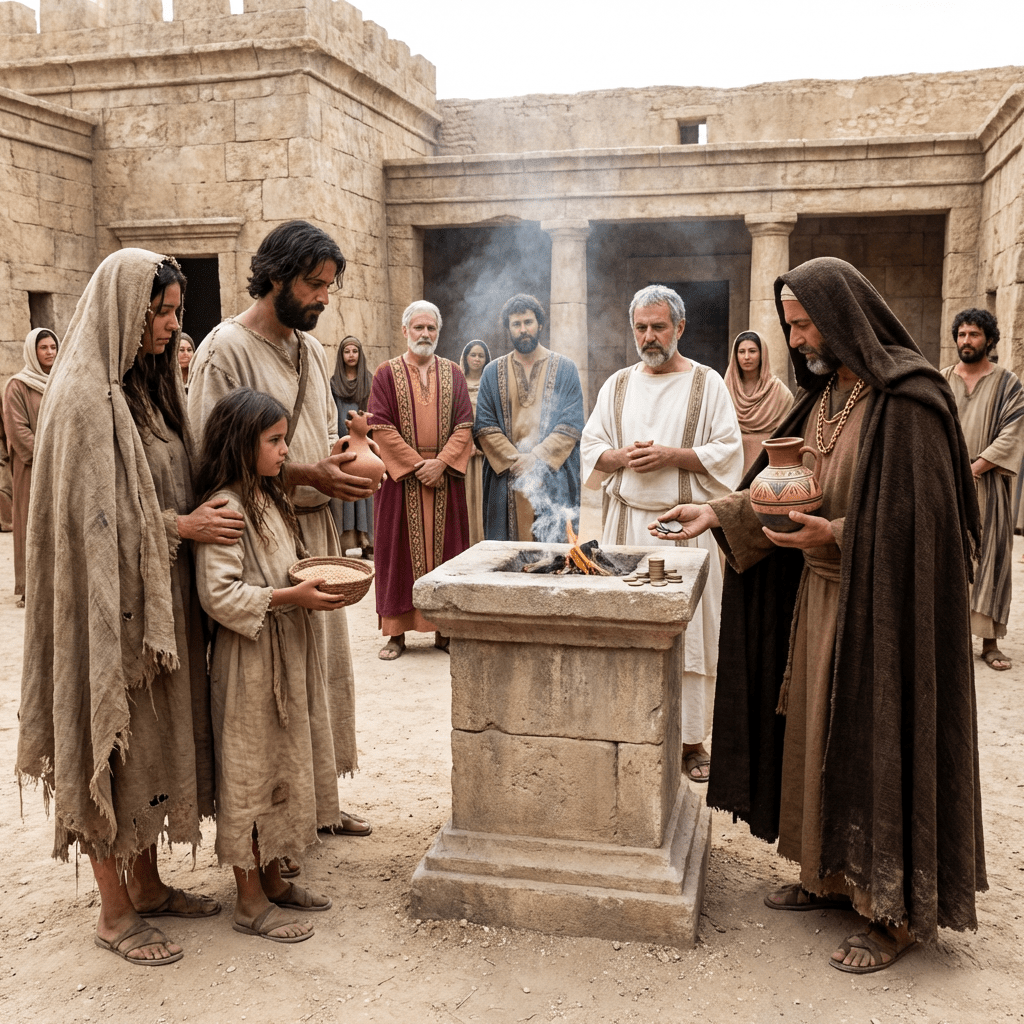
Economic disparity is a civilization byproduct. Accumulated wealth and income earned through labor are two agents contributing to the gap. Individuals without assets and unable to work are set back. As a result, the poor people’s societal participation and opportunities are limited. The Torah, recognizing this problem, addressed the issue within a variety of commandments. No uniform policy, however, was instituted to address the concern. There may have, however, been an underlying philosophy.
To understand this matter, one must venture to a time before the Pentateuch.
In The Beginning
Early civilization, as well, recognized this economic dilemma; social measures in antiquity protecting widows and orphans acknowledged this problem. See Code of Hammurabi (See Epilogue- “That the strong might not injure the weak, in order to protect the widows and orphans.”)
Thus, prior to the Torah, the necessity of some social safety net was appreciated. Thus, the Pentateuch’s rules addressing the poor constituted Israelite innovation as opposed to invention.
The Hebrew Bible
The Hebrew Bible advanced this political-economic dialogue through the various commandments. The text’s composition began during a period of societal upheaval occurring as the Bronze Age transformed into the Iron Age. With the regional civilization collapsing in 1177 BCE; the Hebrew Bible emerged and continued its unique discourse into the Iron Age. While incorporating old Mesopotamian elements, the Hebrew Bible injected an emerging egalitarian philosophy.
The Torah Portion Metzorah contains one of the many scriptural passages advancing egalitarian ideology. Throughout the Pentateuch, however, no specific approach was taken towards promoting egalitarianism. Rather, it appears that a multitude of methods were employed.
Thus, while there was the opinion that society included the haves and the have nots, no universal approach was taken to address the poor’s participation in society. Within the multiple approaches employed, however, a common thread exists.
To discover this common thread, a Metzorah passage will be compared with other Torah provisions.
Metzorah
The Portion Metzorah addresses both ritual and treatment measures for skin disorders. Given the ritual nature, sacrifices were required via a Priest.
With respect to a particular sacrifice, there was the following accommodation: “[a]nd if he is poor, and his hand cannot attain enough, then he shall take one lamb, a guilt offering, for elevation, for making atonement over him, and one-tenth of a measure of fine flour mixed with oil for a grain offering and a log of oil and two turtledoves or two pigeons, whichever his hand can attain, and one shall be a sin offering and one a burnt offering.” Leviticus 14:21-22. [emphasis added]
To address inequity, the sacrifice’s cost was scaled based upon the individual’s financial condition.
A different approach, however, was taken with inequity in addressing the annual Tabernacle contribution.
The Half-Shekel
A financial contribution requirement was assessed in the Torah on the population address the Tabernacle’s maintenance.
The edict was that “[e]veryone who passes through the counts shall give this: half a shekel, by the shekel of the Holy (the shekel is twenty gerah); half of a shekel as a donation to the Lord. Everyone who passes through the counts, from twenty years old and up shall give the Lord’s donation. The rich one shall not multiply, and the poor one shall not diminish from the half of a shekel.” Exodus 30:13-15. [emphasis added]
With this approach, a uniform affordable amount was established. Further, a ceiling was created with respect to wealth; all individuals were treated equally.
This approach, however, was not taken with respect to matters of agriculture. A different methodology was used with respect to food access.
The Fields
The Torah, in Leviticus, recognized the need to provide the poor and strangers access to food. Landowners were required to provide access to their fields for others to obtain food. “And when you reap your land’s harvest, you shall not finish harvesting your field’s corners, and you shall not gather your harvest’s gleaning. And you shall not strip your vineyard, and you shall not collect the vineyard’s fallen fruit. You shall leave them for the poor and for the alien. I am the Lord, your God.” Leviticus 19:9-10. [emphasis added]
The imposition of this landowners’ responsibility is best appreciated given the background. First, the land was provided to the landowner via the covenant- the Ten Commandments. Second, the Torah’s Jubilee provisions protected the land; it could never be dispossessed. Therefore, as the landowners were gifted tremendous legal protections, it would not be unreasonable that they would have a societal obligation in exchange.
With respect to those in need, there was an expectation that the poor and strangers would labor to obtain the fruits and what left in their fields.
Finally, with respect to one’s ability to accumulate wealth through labor, the Sabbath commandment should also be considered within this survey of laws.
The Sabbath
The Decalogue’s Sabbath commandment likewise implemented an egalitarian approach to the holiday.
“Remember the Sabbath day, to make it holy. Six days you shall labor and do all your work, and the seventh day is a Sabbath to the Lord, your God. You shall not do any work: you or your son and your daughter, your servant and your maid and your animal and your alien who is in your gates.” Exodus 20:8-10. [emphasis added]
The commandment makes no exceptions concerning wealth or lack of. Everyone else, the poor was entitled to their Sabbath; a day of rest. With it, however, came the expection of six days of effort.
Commonality
Is there a commonality within the commandments? Yes. The commonality involved is the fact that some effort is involved with each situation to some extent to the beneficiary.
For the sacrifice, a diminished amount is indicated. For the Tabernacle contribution, the amount is fixed and is intended to be affordable by all. For the fields, it is anticipated that those needed the produce or grains would collect them and process them on their own. For the Sabbath, those in need would be required to make the same preparation as others in order to be able to take one day off. Their entitlement to time off was scripturally protected.
Thus, while this is accommodation for those in need, the laws created an expectation of societal participation from the poor. This sentiment arguably was carried forward in Maimonides’ Levels of Charity. Maimonides, who lived from 1138-1203CE, when discussing his highest level of charity, suggested loans, endowments, partnerships and employment for those in need. His measures, arguably, work towards improving the poor’s societal participation.
As such, the Torah, it matters of medical care, cultic participation, acquisition of food, and recreation, imposed effort in matters of need or dispensation.
Conclusion
The Portion Metzorah’s sacrifice requirement accommodation for the poor is part of numerous Torah provisions addressing both an egalitarian philosophy as well as the realties that nations are inhabited by both the haves and the have nots.
This methodology, however, was not the only one the Torah employed. In another circumstance, the one-half shekel- a reasonable minimum- was employed to make the Tabernacle contributinon affordable to the poor.
Beyond that, the Torah, in appreciating the benefits bestowed upon those owning property which was legally protected by the Jubilee laws, required landowners to make available portions of their land for those in need of food. In doing leaving the areas available for others, those needing food were required to labor in the fields in order to obtain it.
Finally, there is the Sabbath. With the day off, the expectation was created as to six days of labor. With that effort, the universally rest period applied.
The common tie within the Torah’s attempts to ameliorate poverty was requiring societal participation of the beneficiaries. In essence, these laws did not create hand-outs; entitlement without participation. This concept, arguably, was appreciated with the medieval scholar Maimonides’ Levels of Charity. He promoted societal participation and partnerships for those in need to address the concerns.
In the end, does handing out benefits without some exchange or expectation present as a societal danger? Further, does it discourage the poor from societal engagement and possible elevation? With respect to these concerns, one can only speculate as to whether this was a Torah’s concern. Through a survey of various commandments along with a renown scholar’s insights into charity, the answer may be “yes.”
Be well!!
Please like, follow, comment or share
 The Ten Commandments Project
One thought on “Metzorah: The Common Thread on Societal Needs Revealed”