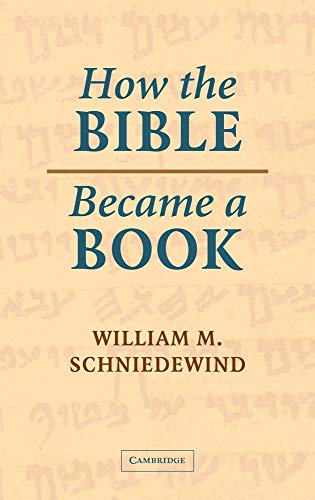
In How the Bible Became a Book: The Textualization of Ancient Israel, Professor William Schniedewind provides a plausible theory when scripture transformed. Once what was the authoritative oral tradition became supplanted by the emerging technology of writing.
The book’s importance is beyond scriptural analysis. Rather, it presents as an episode of humanity confronting and struggling through a period of technological change.
To reach his goal of explaining how the Bible became a book, Professor William Schniedewind explores history, scripture, technological realities, and linguistics. He cobbles aspects from each of these to come up with a coherent theory.
When reading his book, one must appreciate how the innovative technology of writing re-shaped history, politics and theology.
The Grand Scheme
How the Bible Became a Book, in the big picture, constitutes a study of technological transfer from one medium to the next. Technology changes challenge humans. Resistance and acceptance of these advances naturally occur. Matters of authority arise; status quo is challenged.
Recent technological transfers allow readers to relate to what occurred in antiquity. At one point, orally passed down songs as well as sheet music became transferred to a vinyl recording medium. These, in turn, became Compact Discs which would eventually become MP3 files. Additionally, codices and books would be reduced to 0s and 1s in computer accessed digital files.
When these transfers occur, there are matters of distinction. This is what Professor Schniedewind lays out through his book. Within this scheme, some people hold onto the old medium with authoritative orthodoxy while others take to the new. As the book reveals, these changes do not initially take hold. The bumpy road towards adoption of writing as an authority is addressed by Professor Schniedewind.
Thus, the book takes scripture through its lengthy textualization process.
Change
How the Bible Became a Book is about such a change. What was Oral Tradition became writing. Once written, the writing challenged the oral. This is part of the conflict with existed for hundreds of years.
How the Bible Became a Book, in reaching its conclusions, surveys both the historical landscape and source material that gave rise to scriptural composition. Professor Schniedewind’s multi-factorial analysis explores not only the motivations behind the composition but the actualities of the technology of writing.
He further discusses the inevitable tensions arising with the advent of writing; oral authority tradition versus written authority tradition. In this process, authority is essentially ripped away from human memory to become written composition. With this, the theological authoritative landscape was forever transformed. “Whether the rise of texts led to the fall of Prophets?” is one of the questions raised.
Professor Schniedewind’s discussion includes two important factors which provide substantial data to his thesis: technology and language. What language was employed writing matters. Likewise, there is the question whether the socio-economic environment particular periods could support a scribal community. These two factors are important in locating time periods for the Hebrew Bible’s composition.
One of the historical realities during the period of scriptural composition was the flux of language.
The State of Language
How the Bible Became a Book looks towards language for clues. Professor Schniedewind explores the languages present in the region over the course of the period upon which the scripture was composed.
Most importantly, the lingua franca of the region shifted. Aramaic, for a period of time, dominated.
Scripture notes this problem. By the time Ezra reads from the scripture, Hebrew appeared to already be a dead language. A language perhaps preserved and studied by Levites.
With Ezra, the audience does not understand the “Hebrew” text: it must be translated to them. Regardless of whether the account is true or not, it speaks to the actual reality; the Hebrew language was on life support.
Aramaic was the region’s dominate language during a period that scripture was still not yet canonized. Thus, those composing such works writings during that period would likely show signs of the present, i.e. a use of an Aramaic word or phrase- loan words.
Motivations
Given this background, why would anybody generate Hebrew writing during that period of time? If one wanted to spread, promote, and gain ready acceptance of ideas through writings, one certainly would have produced material in Aramaic. Likewise, the individuals composing writings during that time would likely have had their primary language as Aramaic. Again, one would expect Aramaic to leak into their writings, i.e. loanwords.
These are that the realities that Professor Schniedewind explores. This suggests that a considerable part of the Hebrew Bible was in a preservation state during the Second Temple period. Within the text, he identifies parties that likely had an interest in saving the First Temple Israelite writings.
Technological Changes
For those in Biblical times, what was oral became written. With this change, old data became transferred to the new medium. Once in writing, the words took a life of their own.
In essence, the old poetry, songs, tales, and genealogies became reduced to writings. Laws and priestly instructions became writings. Some matters of authority- by writing- became set in stone.
The Unanswered Questions
While How the Bible Became a Book provides a factual analysis as to when scripture was reduced to writing, it leaves with unanswered questions worthy of another book.
While it addresses scripture’s textualization, there are additional questions concerning the canonization of the writings.
How and who controlled the scrolls which would eventually make into the Hebrew Bible?
How and where they were maintained?”
Who had editorial control and who was authorized to actually write the holy words?Were there master scribes tasked for this role?
Who was responsible for curation and care of scrolls?
What were the purposes for scroll copies? Were they for education? Entertainment or communication?
Was the copying of scrolls left to a minimum?
Finally, how many libraries existed from the First Temple period moving forward?
Conclusion
In sum, How the Bible Became a Book provides an extensive journey that logically- based upon extensive sources- takes the reader to a plausible explanation of how and when the Bible became a book. For this alone, it is highly recommended. Not only it is valuable in terms of the content and data points to present the theory, Schniedewind’s methodology and technique provides an excellent template.
Ironically, the word How can be re-configured into the word Who. While the text does not specifically identify individuals, Professor Schniedewind does an excellent job identifying the groups likely involved in the process. Further, in the big picture, he documents an important period of technological transformation.
Be well!!
Please like, follow, comment or share

