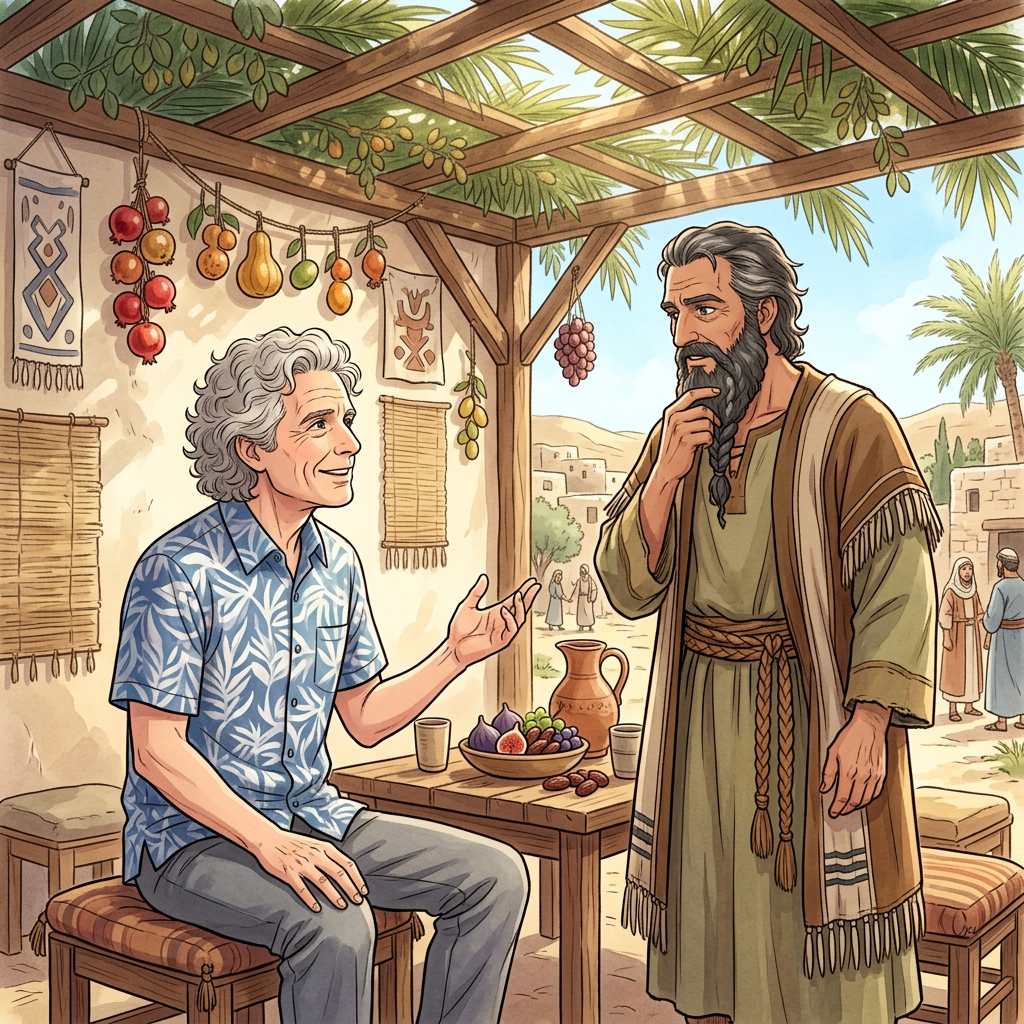
Steven Pinker examines Common Knowledge in his work: When Everyone Knows That Everyone Knows…: Common Knowledge and the Mysteries of Money, Power, and Everyday Life (2025, Scribner.) Dr. Pinker’s Common Knowledge is a term meant to describe human interactions and the knowledge of the individuals interacting. The Sukkoth Holiday- the Festival of Booths- Torah Portion surprisingly connects to Dr. Pinker’s research. A specific Torah passage for the holiday reveals that the Creator of the Universe also created some Common Knowledge.
Pinker’s Common Knowledge
Pinker’s Common Knowledge is not like Common Sense. The term isn’t necessarily about valuable knowledge, nor is it about essential knowledge, but rather it is a term addressing both the act of knowing and the knowledge known by others.
The act of knowing, in Common Knowledge, is taken to the next level. It involves human interaction. Common Knowledge is about not only what people know but also what people know that other people know. In a crude fashion, it is mind reading with some level of certainty.
For clarity’s sake, Pinker’s Common Knowledge term will be spelled out. This is necessary to appreciate the Torah’s application of the terminology.
Pinker sums up this cognitive process as: “With common knowledge, A knows something, and B knows it, but in addition, A knows that B knows it, and B knows that A knows it. On top of that, A knows that B knows that A knows it, and B knows that A knows that B knows it, and so on, ad infinitum.” Common Knowledge and the Mysteries of Money, Power, and Everyday Life (2025, Scribner)
Common Knowledge’s Value
This concept is essential for civilization to exist.
Common Knowledge helps societies operate. It impacts the ability for people to coordinate with others. It allows for the creation of social networks. These networks can include communities, economies, and nations. He notes that many mindless rituals, conventions and norms become intelligible as solutions to coordination problems. Further, he notes it plays a role in bonds with “family, friends, lovers, authorities, subordinates, neighbors, colleagues, and transactional partners.” When Everyone Knows That Everyone Knows…: Common Knowledge and the Mysteries of Money, Power, and Everyday Life (2025, Scribner)
One of Dr. Pinker’s examples is of driving on the right side of the street. In the United States, not only do drivers know this, but they know that the other drivers do as well. This Common Knowledge allows for the operation of efficient and effective roadways.
As Pinker notes, Common Knowledge can create bonds. This concept, as evidenced in the Torah Portion to be discussed, was it was well understood in antiquity.
Common Knowledge’s Value in Religion
Common Knowledge- and the creation of it- is not something new. The Torah contains a passage from the Sukkoth Holiday- the Festival of Booths- that Dr. Pinker could have used as an excellent example of how Common Knowledge is established. In this instance, not only did the passage create Common Knowledge, it also created “generational” Common Knowledge.
Pinker’s Common Knowledge process arguably focuses on contemporaneous matters. The A and B discussed within this framework live with each other in the present. The Torah’s methodology was done with the intent of establishing Common Knowledge that extended beyond the present. It also extended into the future and the past.
Sukkoth’s Common Knowledge
In the Sukkoth Torah Portion reading, there is the following passage: “You shall live in booths seven days. Every citizen in Israel shall live in booths, so your generation will know that I had the Children of Israel live in booths when I brought them out from the land of Egypt.” Leviticus 23:42-43.
This passage established a requirement for the religious holiday of Sukkoth- the Festival of Booths for every individual. As this biblical holiday is still presently practiced, one can likely visit an observant Jew’s home and see that they have made a Sukkah- a booth-like structure. This Sukkah is to be used for the holiday week.
Beyond establishing the holiday observance, the passage created Common Knowledge.
How Did the Passage Create Common Knowledge?
Given the passage’s instructions, everyone knows that everyone else knows that they are all to live in booths for seven days. This is because everyone was required to participate.
And, every generation knows that everyone else knows that the generation brought out of the land of Egypt lived in booths.
And, everyone knows that everyone else knows that everyone knows that in each generation everyone lived in booths. And, every generation knew that every other generation knew that every other generation knew that those taken out of Egypt all lived in booths.
Sukkot’s Reality?
Common Knowledge of Sukkoth, however, contains some mystery. Scripture evidences that there was likely a lapse in its observance. It appears that after the First Temple’s destruction and the return from exile, the Sukkot Holiday may have been revived by Ezra.
In the Book of Nehemiah, it is reported that Ezra, the priests, family heads and Levites found the commandment to engage in the Sukkoth holiday. Nehemiah 8:14. It was determined that “they should proclaim this word and spread it throughout their towns and in Jerusalem: “Go out into the hill country and bring back branches from olive and wild olive trees, and from myrtles, palms and shade trees, to make temporary shelters”—as it is written.” Nehemiah 8:15.
It is noted that the entire congregation that returned from exile made Sukkoth and dwelled in a Sukkah. Nehemiah 8:17. It was noted that the holiday had not been celebrated like that since the days of Joshua. It was a moment of great joy. Nehemiah 8:17.
Given that it had been approximately 70 years since the First Temple’s destruction and the time in exile, the nature and extent of the Holiday’s celebration was perhaps murky. Perhaps, it had fallen out from being Israelite Common Knowledge. It is possible that the event described in Nehemiah revived the holiday and revived it to once again become Common Knowledge. Within the passages, it is noted the entire congregation celebrated it. So, from that point moving forward, Common Knowledge from the holiday was once again known
Conclusion
The Sukkoth Torah Portion provides a unique moment in which the holiday’s pronouncement was crafted in a way that it would become Common Knowledge. It not only established the requirement of living in the booth, it also worked to inform those participating as to the reason. Beyond that, it created generational Common Knowledge.
It is quite possible that as a result of the Judean nation’s destruction and exile that the holiday’s Common Knowledge fell off. It, however, was likely revived by Ezra.
Be well!!
Please like, follow, comment or share


One thought on “Next Level Common Knowledge: Sukkoth”