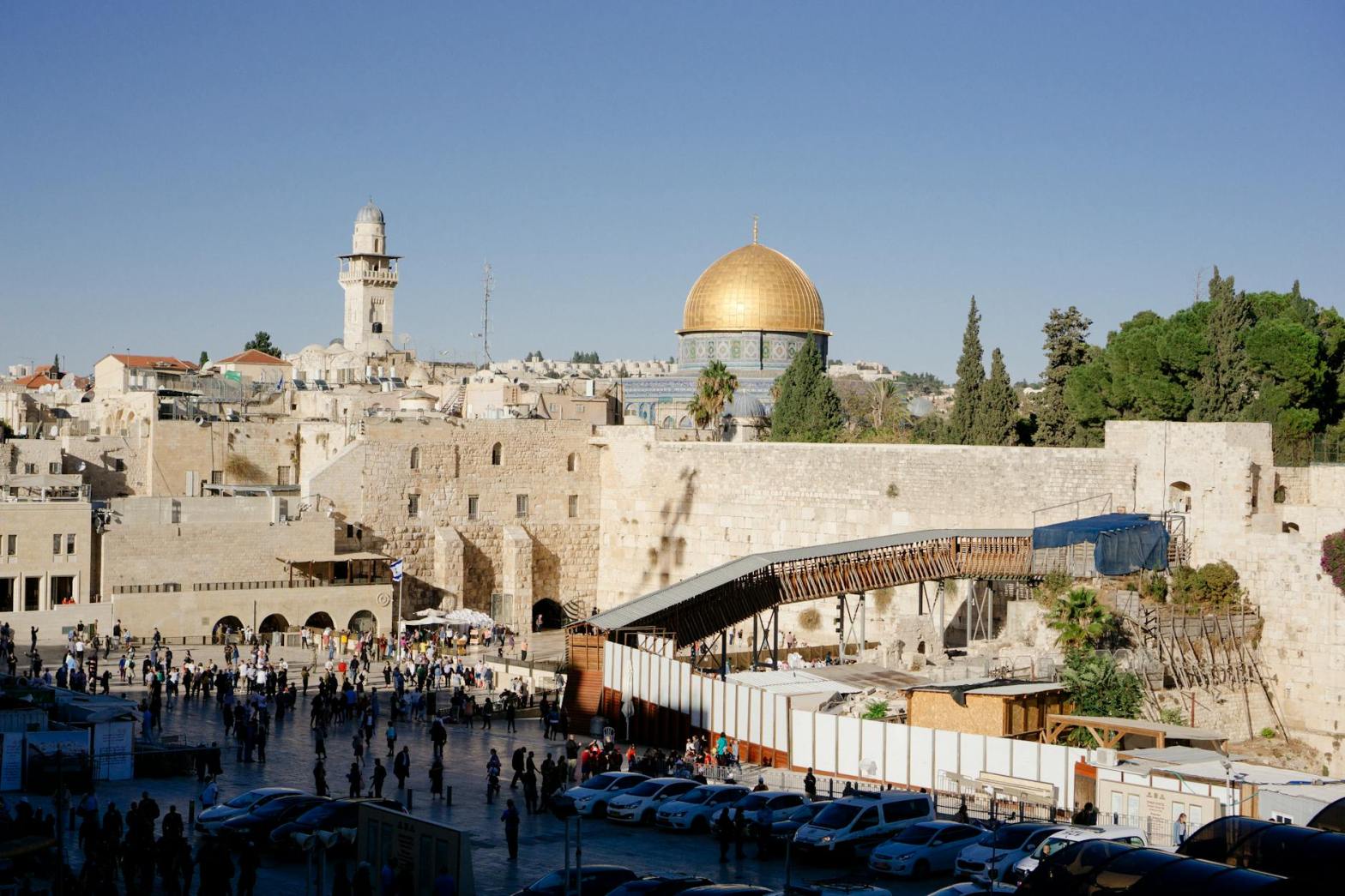
And all the work that King Solomon had wrought in the house of the Lord was finished… And the Lord has established his word that he spoke, and I have risen up in the place of David my father, and sit on the throne of Israel, as the Lord spoke, and have built a house for the name of the Lord, the God of Israel.
1 Kings 7:51, 8:20
Haftorahs- supplemental readings from the Hebrew Bible’s Prophets- are read weekly with Torah Portions. Pedukei’s Haftorah reading from the First Book of Kings marks a multi-dimensional Ten Commandments’ moment. With the Temple completed, the Ten Commandments are placed within Solomon’s Temple in Jerusalem.
Pedukei’s Haftorah concludes with King Solomon declaring ” And I have set there a place for the ark, wherein [is] the covenant of the Lord, which He made with our fathers, when He brought then out of the land of Egypt.” 1 Kings 8:21.
Solomon fulfulls the Commandments to honor one’s parents as he completed the project tasked for him. One must appreciate the gravity and the immense responsibility to have constructed such an important structure.
Further, the Temple being the house for the name of the Lord is something worth exploring. At the time that the Temple was constructed, what was the state of writing? Further, what was policy concerning reducing the Tetragrammaton into writing? Was the writing God’s name only to be located on sacred sites? Were there sacred scrolls that existed with limited access to the priestly class? Were they kept in a sacred place? In other words, the time that the Temple was built, was there a rarity to writings of the Lord’s name? If so, were the Commandments one of the few items on the planet that had the name in writing?
Presents times are quite different; we have millions and millions of books on this plant with the Lord’s name. Thus, there is some irony concerning this immense multitude of pages and parchment that exist on the planet when the house for God’s name no longer exists. Both the First and Second Temples were destroyed.
The Hebrew Bible tackles is the notion of centralization of the religion. While the Temple was built, the Hebrew Bible despict that struggles existed over a centralized location for religious practice. With the destruction of both Temples, however, those praying face Jerusalem. One could argue that the memory of the Temples solidified that centralization. Judaism is now uni-directional.
With Mt. Sinai, Moses brought the Ten Commandments down from the mountain to the Children of Israel. With the Pidukei Haftorah, the Ark containing the Decalogue is being returned to a high place to rest. With this, many thoughts attach to this event. Are we valuing the content of the Ten Commandments? In the portion, we have an honoring of one’s parents. With respect to the Tablets, are they, at that point, recognized as one of the few writings of the Lord’s name? Was the name this venerated? With respect to the concept of centrality, over much conflict and destruction, the location of where the commandments once resided became the traditionally direction for prayer. Thus, did the dispute over centrality get resolved via destruction?
Be well!!
Please like, follow, share or comment.
 The Ten Commandments Project