Societal literacy?
Is it possible to instill a nation’s rules, morals and values upon all residents?
Why do it?
The Torah Portion Vayelech offers insight into the how and why?
The Setting
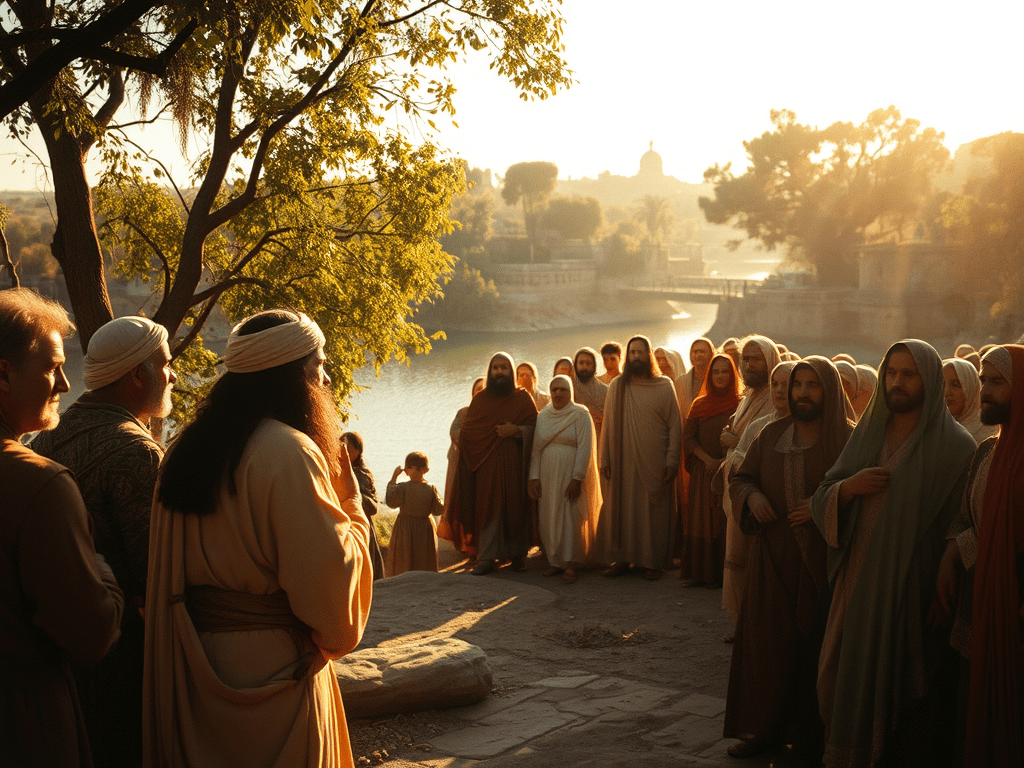
Vayelech’s events occur while the Children of Israel camped out on the other side of the Jordan River. They are awaiting entry into the Promised Land. Moses is continuing to give his address to the fledgling nation. Moses, their leader of forty years, is to step down and pass the leadership torch to Joshua. Moses would not be crossing the Jordan to enter the land.
This was also a moment that a societal literacy project was announced. At the time, the nation was absent any formal education system. Those to be educated where the Children of Israel, the progeny of slaves freed from bondage, as well as a mixed multitude of others.
Vayelech describes the initial methodology that was to be employed to achieve the ambitious societal literacy goal. To have residents learn of the rules, values and morals of the nation was the goal of “social literacy”.
The Literacy Project Per Vayelech
This project is laid out in a short passage.
It states that “when all Israel comes to appear before the Lord, your God, in the place that He will choose, you shall read this instruction in front of all Israel in their ears. Deuteronomy 31:11.
[note: The place that “He will choose” was likely where the Tabernacle and the Ark of the Covenant were located. The Ark’s eventual location was the Temple in Jerusalem.]
The passage provides further instruction.
“Assemble the people-the men and the women and the infants and your alien who is in your gates- so they will listen and so they will learn and will fear the Lord, your God, and they will be watchful to do all the words of this instruction.” Deuteronomy 31:11-12. [This passage refers to the time of Succoth, the Festival of Booths.]
In essence, societal literacy was existential towards the nation. It was perceived so necessary that it justified the cessation of all other activities. Educating the country’s residence was paramount.
This task as well created an expectation upon the residents. There was a need for them to participate and learn.
For the presenters, there was the challenge of being masterful communicators. When addressing a diverse audience, they had to achieve the goal of having people not only listen, but also learn. This is a difficult task.
The Literacy Project Post-Torah
Regional conflict and the ever changing landscape of Levant challenged this social literacy project.
After the Israelites established their government, there was a split into dual monarchies- Israel and Judah.
Both Israelite nations were then conquered by the Assyrians. This included the destruction of the First Temple as well as the imposition of exile. Thus, location which was supposed to host the event no longer existed.
Under Persian Empire rule, Cyrus the Great granted the Israelites the opportunity to return to Jerusalem and rebuild the Temple. At that point, the social literacy project required a re-boot.
The Hebrew Bible captured this moment in the Book of Nehemia. It was told that “… Ezra the priest brought the Law [scroll of the Law of Moses] before the congregation, both men and women, and all who could hear with understanding, on the first day of the seventh month.” Nehemia 8:3:2
At this event, the nature of the residents had changed. It was a different world and the Hebrew language was losing its fluency among the population. Languages such as Aramaic, became primary in the region.
Thus, the changing demographics may offer explanation for the following passage from Nehemia: “… the Levites explained the Law to the people, and the people stood in their place.” 8:3:7 Additionally, it is noted that “…they read in the scroll, in the Law of God, distinctly, and gave sense, and they explained the reading to them.”
Thus, under the Ezra’s direction, the pedagogy to teach societal literacy among the populace evolved.
The project was confronted with the growing reality that the instruction required commentators and interpreters. The nature of world and languages was rapidly changing as well as the general notion of literacy envisioned in Vayecha.
Rationale
Why would a society impose such a program?
In the big picture, it created a great sense of community; a cohesiveness to ideas. Each member expected the others to act in accordance with the rules, morals and values. To some degree, disparate people could unify themselves around the instructions, the Torah.
Also, at the time, there may have been a concern over the loss of leadership and its impact on the society. Moses, at the time, was not only the leader of the new nation, he was the authority concerning the Torah. Therefore, this educational program was to act as a bridge to future generations.
In a smaller sense, the mass education created a sense of fairness. A “due process” of sorts. People were well aware in advance of what was a violation. The other benefit is that it removes from society the notions of ignorantia juris non excusat. In essence, the concept of ignorance of the law not being an excuse would no longer be required.
Conclusion
The governance philosophy tied to the Ten Commandments extends far beyond the writings on two tablets brought down by Moses from Mt. Sinai. The Decalogue, and the Torah, provided a greater vision both towards education and societal engagement. It also recognized that there was a need for a bridge from generation to generation.
This project created a societal expectation for all to feel that they were included. It created the expectation that all should learn. Since they all shared in the learning, they were able to share it among themselves. While they may have spoken different languages, they knew of the Torah’s text.
The lessons from this project includes that there is the need to adapt. When confronted with an ever evolving world, the program adjusted its pedagogy in order to effectively reach their audience.
In modernity, given many social trends, are nations even capable of expressing their rules, morals and values? Further, are any nations committed to embarking on such an educational program? Would such a project be worthwhile?
Be well!!
Please like, follow, share or comment
 The Ten Commandments Project
2 thoughts on “The Societal Literacy Project: Vayelech”