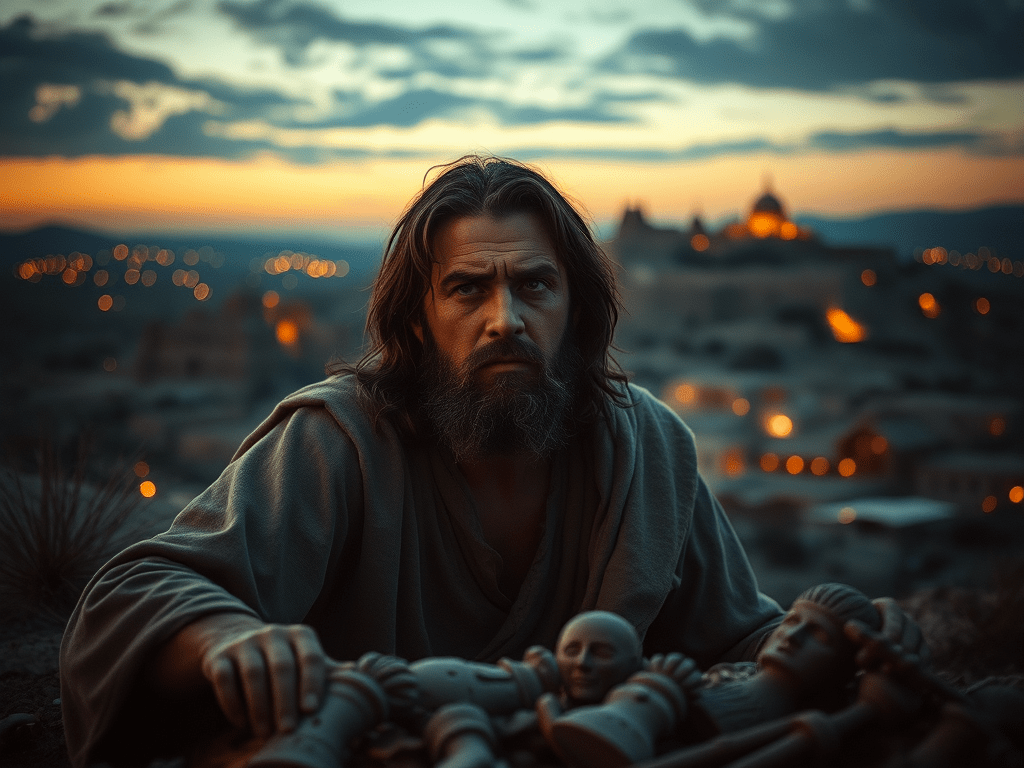
The Torah Portion analysis should never be done in isolation. The Portion Vayishlach connect intimately with both past and future Torah Portions. Merging the texts unleashes deep context which includes a Ten Commandments’ moment.
Vayishlach’s Decalogue moment happens at a time of crisis. Jacob’s sons Simeon and Levi’s committed horrendous acts, the Jacob must respond.
The two sons’ response to their sister Dinah’s entanglement with a local Chieftain’s son, was problematic. The two engaged in a massacre within the City of Shechem. While in the process of retrieving their sister, the two brothers also killed every male city dweller. Genesis 34:25-26. Additionally, the brothers captured and despoiled the city’s wealth. They took with them the infants and wives.
Upon hearing of his sons’ actions, Jacob was distressed. He feared that the violent affair damaged his reputation with the other Canaan residents. Genesis 34:30.
After the incident, Jacob is called upon by God and instructed to live at Beth El.
There, the following occurs:
“And Jacob said to his house and everyone who was with him, “Put away the foreign gods that are among you, and be purified and change your clothes; and let’s get up to Beth El, and I’ll make an altar there to God, who answered me in a day of my trouble, and He was with me in the way that I went.”
And they gave all their foreign gods that were in their hand and the rings that were in their ears to Jacob, and Jacob stashed them under the oak that was by Shechem. Genesis 34:2-4
The Past and the Future
To fully grasp this event, the Torah past and future must be explored.
Prior to this Shechem incident, a controversy had occurred with respect to Rachel’s theft of her father Laban’s idols. After taking them, Rachel left with Jacob and the family to return to Canaan. Laban pursued them and there was a confrontation.
Laban, Jacob’s father-in-law, accused him of stealing his gods [idols.] Genesis 31:30. In response, Jacob told Laban “Let the one with whom you’ll find your gods not live” Genesis 31:32. The idols were never found. Unbeknownst to Jacob, however, it was Rachel, his wife, who had stolen them. Genesis 31:35.
At the time of Jacob’s pledge, nothing happened to Rachel. Genesis 31:35. Scripture also never reveals the disposition of Laban’s gods. Did Rachel keep them? Were they in her possession at the time that Jacob buried the idols? At that moment, did she hand it over to him?
After Vayishlach, there is Exodus’ Golden Calf incident. Moses’ brother Aaron, in that moment, crafted the graven image. Aaron directed the Children of Israel to “[t]ake off the gold rings that are in your wives’, your sons’, and your daughters’ ears and bring them to me. ” Exodus 32:2.
The source of the rings is also of interest. Prior to the Golden Calf incident, Exodus tells of how the gold was obtained during the Children of Israel’s departure from Egypt.
Pursuant to Moses, the Children of Israel asked for items of gold and silver from the Egyptians as well as garments. Exodus 12:35. It was reported that God had put the people’s favor in the Eqyptians’ eyes, and they lent to them, and they despoiled Egypt. Exodus 12:35-36.
Vayishlach’s Take Aways
With all of this information, Vayishlach makes more sense. After Jacob buried the idols and gold, he is confronted two tragedies. First, Rachel’s midwife passes. Genesis 35:8. Shortly after her passing, Rachel dies after childbirth. 35:19. Is it possible that this represented the fulfillment of Jacob’s pledge to Laban? One can speculate that at Beth El Rachel disposed of Laban’s idols. Since Jacob buried the items, it is quite probable that he then knew that Rachel was the thief. Thus, the chronology may not have been coincidental.
Likewise, the burial of the earrings makes sense in light of the happenings at Mt. Sinai with the Golden Calf. Did Jacob anticipate that the rings could have been fashioned to create a graven image?
One of the Portion’s themes is the challenge of how to incorporate strangers into society dedicated in practicing monolatry. Maintaining a uniform belief system was existential. This topic’s tension reoccurs throughout throughout the Hebrew Bible. Arguably, the anchor towards the unified belief system was the Ten Commandments which forbade idolatry.
Be well!!
Please like, follow, share or comment
 The Ten Commandments Project
2 thoughts on “Idol Reflections: Vayishlach’s Ten Commandments’ Moment”