“There shall be one instruction for the citizen and for the alien who resides among you.”
Exodus 12:49
Modern sensibilities are a barrier towards education. Loaded with troubling passages, The Torah makes a perfect target for contemporary erasers and white washers. Problematic events, offensive words and horrifying circumstances serve as pedagogical tools. Those representing morality cannot come to grips that morals and values are richly taught via confounding tales with troubling moments. A Torah Portion Miketz passage illustrates this notion.
Joseph the Egyptian
Miketz tells of Joseph’s rise to become Eqypt’s second-in-command as a result of his ability to interpret the Pharoah’s dreams. While in charge of food storage and distribution, Joseph encounters his brothers. At the behest of their father Jacob, they have ventured down from famine plagued Canaan to Egypt to purchase food.
At their encounter, Joseph is unrecognizable to his siblings. He has been incorporated into the Egyptian ruling class. He even has a signet ring to prove it. Genesis 41:41:43.
Miketz tells of a series of encounters taking place between Joseph and his brothers. These meetings were not brother to brother. Rather, they were of Egyptian to Hebrew. Joseph, the Egyptian via monarchical dictate, and his brothers, the Hebrews via generational Deital covenanting.
During a meal, it was noted:
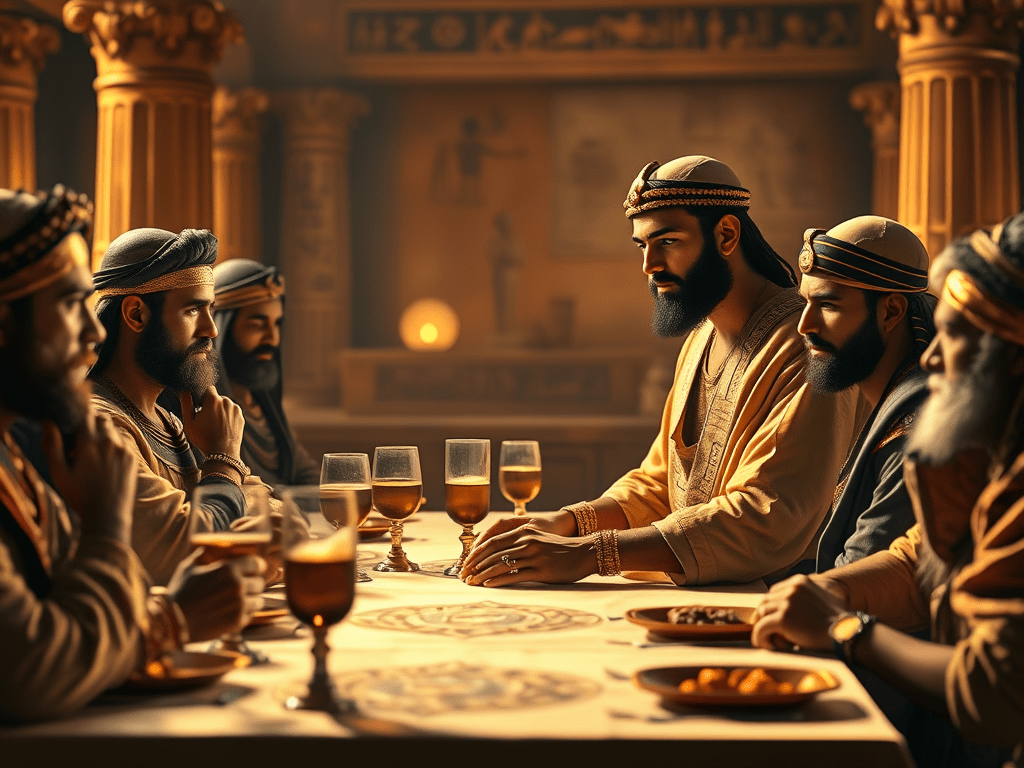
“And they put out the bread for him [Joseph] by himself and for them by themselves, because the Egyptians could not eat bread with Hebrews because that is an offensive thing to Egypt.” Genesis 43:32.
The depiction of segregation, while offensive, is purposeful. Egyptian society had its rules and protocol. This offense, with the reader’s patience, is directional. It marks one point in a line. The reader, to experience enlightenment, must find the other point. That point, is found in the Book of Exodus.
In Exodus, the reader is introduced to the Israelite Passover Laws. These reject Egyptian society. The Israelite culture will depart from their Egyptian experience.
Three Exodus lines display the shift.
“And every slave of a man, purchased with money, you shall circumcise him; then he shall eat from it [the Passover offering].” Exodus 12:44.
“And if an alien will reside with you and will make a Passover to the Lord, let him be circumcised, every male, and then he may come forward to do it, and he will be like a citizen of the land.” Exodus 12:48
Finally, “[t]here shall be one instruction for the citizen and for the alien who resides among you.” Exodus 12:49.
The Educational Payoff
Thus, moving from Miketz experience, Torah illustrates the rejection of the hierarchy of Egyptian society. The change in societal behavior in formal eating serves to make this point. This past allows for the understanding and appreciation of the shift towards an egalitarian based society.
The Israelite society was to be one open to aliens who was willing to abide by the laws of the land. The same laws that applied to citizens would likewise apply to them. The fact that even a slave was to be afforded participation in the Passover offering plants a seed.
Conclusion
Thus, the Torah transforms the problematic into a morally uplifting moment. The past must be appreciated by those who seek to improve upon it.
With this notion readers’ minds can explore the inevitable questions. In this case, for millennia, readers were compelled address whether the institution of slavery was something to move past. While the Torah provides two points to a line, perhaps the Torah is suggesting that the line has three points.
In sum, the past and progress inspires the trajectory of thought and morality. While it would be improper for Passover Laws to provide a breadcrumb path towards enlightenment, certainly one can say that the exploration of multiple passages yield enrichment and inspiration.
Be well!!
Please like, follow, share or comment
 The Ten Commandments Project
2 thoughts on “The Past Should Be History: Miketz”