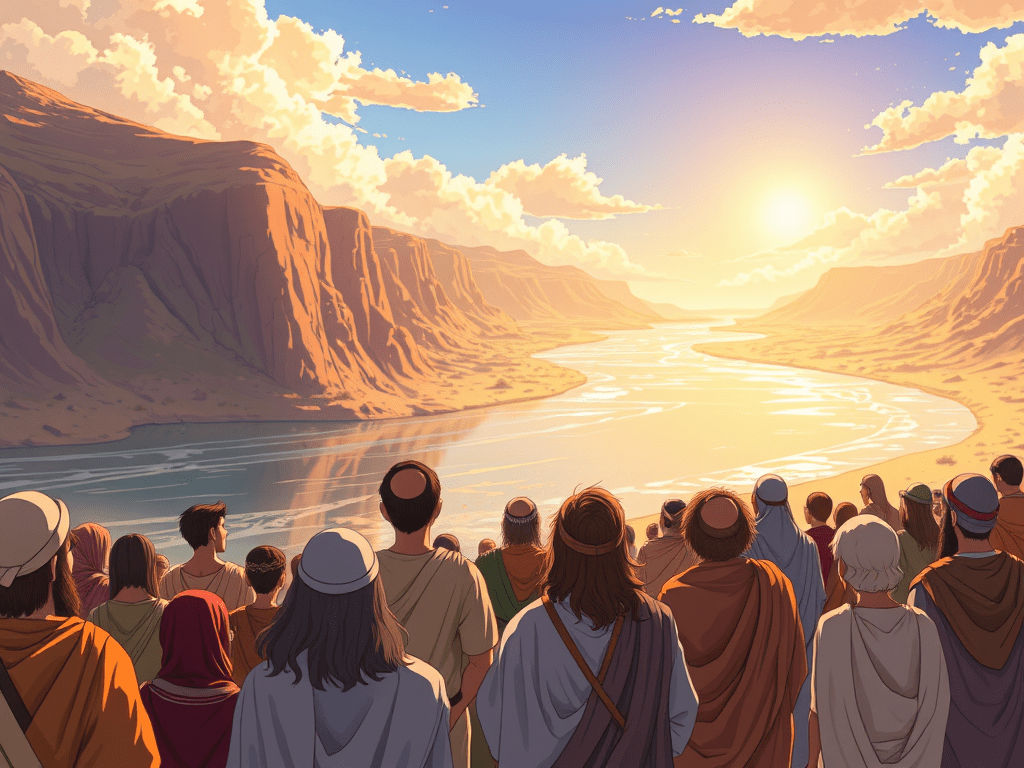
“… be watchful to do all the laws and the judgments that I’m putting in front of you today.”
Deuteronomy 11:26
Before crossing the Jordan River into the Promised Land, the Children of Israel are reminded about their Divine Covenant. Laws and judgments are to be followed.
In juxtaposition, the Patriarch Isaac is confined to the Promised Land. In the Torah Portion Toldot– in spite of famine- he is divinely instructed to not leave.
In Isaac’s conversation with God, his covenantal obligations are further revealed. These arguably included adherence to the law. See Genesis 26:6.
These two cautionary tales raise a number of questions: were the Children of Israel’s laws from Mt. Sinai the same as the Patriarchs? If not, what differed? The significance reveals how the Torah serves as a governance textbook.
Toldot
God, in Toldot, tells Isaac, that his covenant’s continuation is “because Abraham listened to my voice and kept my watch, my commandments, my laws, and my instructions.”
Isaac, advised by the Lord to remain in the Promised Land, stayed in Gerar. He did not go to Egypt. Genesis 26:5-6. In his lifetime, he never left the Promised Land.
From the above-stated passage, one must assume that Abraham passed onto Isaac the referenced commandments, laws and instructions.
The passage, however, is unclear. What exactly was the Israelite legal corpus prior to Mt. Sinai?
Religious Commentary
Commentator Rashi recognized Toldot’s problematic language and attempted clarification. Within his explanation, he made the following points:
Commandments: Rashi offered: “מִצְוֹתַי – My commandments. This refers to those matters which, even if they were not written in the Torah, would have been fitting to be given as commandments, such as the prohibition of robbery and murder.”
[Note: What did he mean by this? Biblically, there were the Noahide Laws to reference. Historically, sophisticated legal systems were already in existence, i.e. the Code of Hammurabi. Both biblical and historical laws had provisions similar to what would be presented at Mt. Sinai. If this is the case, what is the Torah? Was it meant to be an evolutionary moment within the concept of law and governance? If so, what was it?]
My Laws: Rashi further explained: “חֻקּוֹתַי – My laws. This refers to those things against which the evil inclination and the nations of the world argue, such as the prohibitions of eating swine and wearing garments made of a mixture of wool and linen, for which there are no apparent reasons but the King’s decree and rules imposed upon His servants.” Rashi
[Note: In this instance, for the Patriarchs, was their “King’s decree” Divine inclination? For instance, do circumcision and sacrifices fall within this inclination category? In a sense, Rashi is arguing about the arbitrary decisions. For those searching to understand Divinity, these are of interest. ]
My instructions: “וְתֽוֹרֹתָֽי – And My instructions. This comes to include the Oral Law – the laws given orally to Moses at Mount Sinai.” Rashi
[Note: Prior to Mt. Sinai, scripture indicates that Patriarchs did possess knowledge not explicitly detailed in the Torah. For instance, with circumcision, constructing altars, and sacrifices all involve details which are not clearly spelled out within Genesis. In the post-Mt. Sinai world, the details concerning phylacteries aka tefillin would be one upon which there was oral knowledge. ]
From Rashi, one can surmise that the embodiment of pre-Sinaic law was oral and not written. If there were writings, perhaps, they may have been those of other nations. Further, it appears that there was an Oral Israelite Legal Corpus that touched upon a variety of topics.
The Scripture
While Rashi’s commentary does not refer to scripture, the Book of Genesis evidences many instances illustrating Israelite legal knowledge. Commandments, laws and instructions are reflected throughout Genesis. They all predate their Egyptian settlement at the time of Joseph.
Within these examples, while there vary, there is significant focus was upon pastoral llife.In the grand scheme, they- the commandments, laws and instructions- address interactions with family members, foreign neighbors, foreign city states, and foreign empires. Further, matters of the divine nature were also addressed.
The Cult
Priestly dictates were present before Mt. Sinai. Abraham capably performs sacrifices. See Genesis 15:9-12, Genesis 22:13. Jacob does so as well. See Genesis 31:54. [“And Jacob made a sacrifice in the mountain and called his brothers to eat bread.”] The referenced matters were animal sacrifices which comport with a pastoral lifestyle.
Beyond sacrifice, the Patriarch’s possessed altar building knowledge. Abraham built altars on several occasions. See Genesis 12:6-7, at the Oak of Moreh; at Beth-El, Genesis 12:8. Isaac built an altar. Genesis 26:23-25.
Pre-Sinai scripture also evidences Israelite knowledge of the continuing practice of circumcision. With Abraham, there was the initial Divine circumcision commandment. See Genesis 17:10-14. With the Dinah controversy, Genesis evidences continued awareness. Jacob’s sons make reference to their awareness of the circumcision commandment. “Only this way will we consent to you; if you’ll be like us, every male among you to be circumcised.” Genesis 34:15.
Individual Conduct
With Joseph, scripturally, there is one particular passage in particular evidencing his knowledge of the legal corpus. When asked to commit adultery by Potiphar’s wife, Joseph responds that it would be a “sin against God.” Genesis 39:9.
Thus, Joseph appreciated that the committing adultery was not merely an offense against a fellow human. He was fully aware that it was an affront to his God. His belief system was aligned with the Decalogue.
Of Outside Dealings
Abraham conducted affairs with City-States. In doing sosohe made his independence clear. He advised ruler of his covenental allegiance. “I’ve lifted my hand to the Lord, El, the Highest, creator of skies and earth.” Genesis 14:22.
Property rights with foreigners was an Israelite concern. With the Cave at Machlapelah purchase was done with an extreme level of sensitivity. Abraham conducted the affair in a fair manner for which there were witnesses to the purchase. See Genesis 23:16.
With Isaac, there were was a water rights’ dispute which required resolution. Genesis 26. [ Note: in essence, moving to another location to avoid conflict]
The Bigger Picture
The Patriarch’s pastoral living revealed a partial view of the the nature of governance. During this period of time, they would have family matters, neighbor matters, City-State, and Nation matters that they addressed.
For the Children of Israel entering the Promised Land, their laws and judgments included another form of governance- governance as a nation. Both internal governance and international relations were matters of concern. Thus, what was built upon with the Patriarchs would be expanded upon to address the new paradigm- nationhood.
Conclusion
From the Torah Portion Toldot, we gain an appreciation of the strata that exists with governance. In Genesis, governance included humanity’s relationships with God, Family, Foreign Neighbors, Foreign City-States, and Foreign Nations. With the Exodus, these governance matters would not only continue, they would also include matters of nationhood. This new chapter created both leadership and land right matters.
Be well!!
Please like, follow, comment or share
 The Ten Commandments Project
One thought on “Toldot’s Ten Commandments’ Moment”