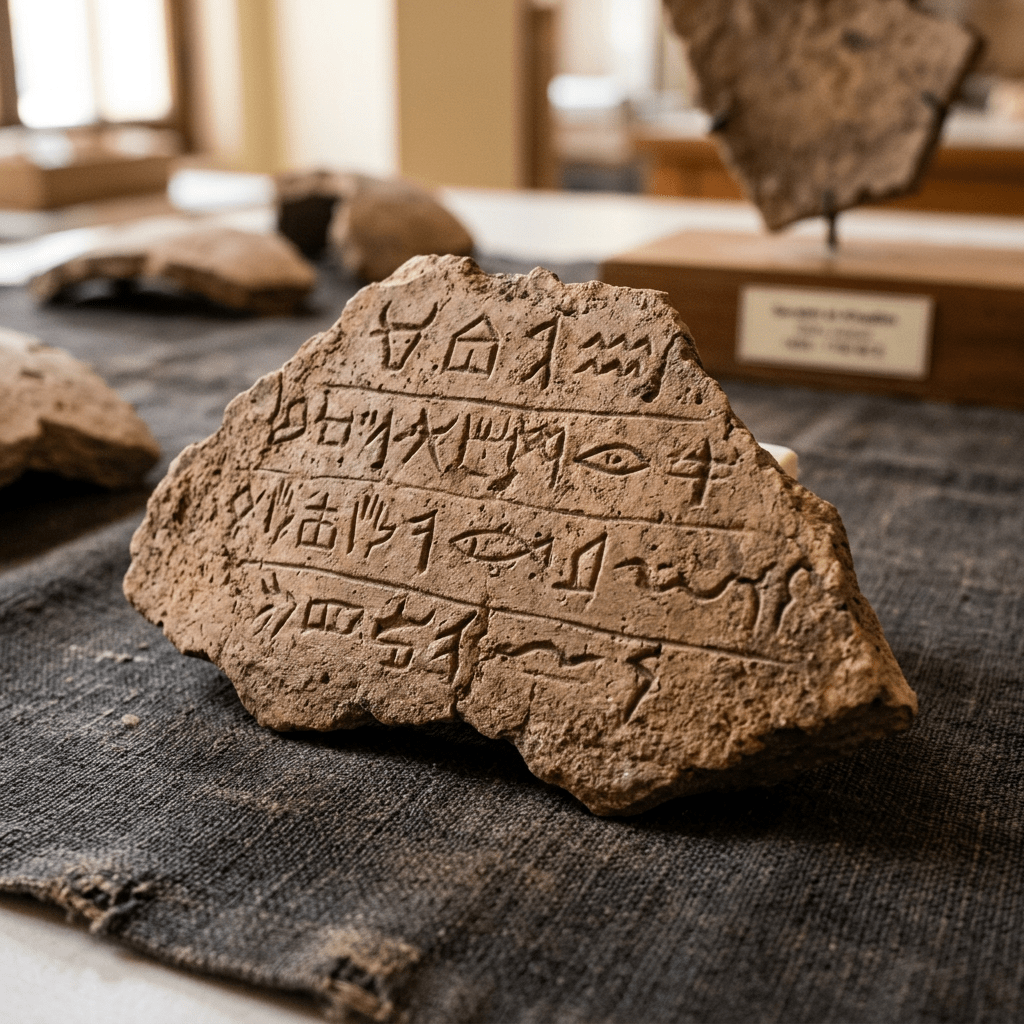
An archaeological discovery provides ample evidence how the Ten Commandments (Decalogue) promotes secular societal values. An ancient pottery shard rather than the Ten Commandments’ two stone tablets proves this assertion. A writing of either a mere scribe or laborer speaks volumes for the one inscribed by the finger of God. Exodus 31:18. The scribe or laborer’s writing evidence that ancient society was influenced the Ten Commandments’ secular values.
The Mesad Hashavyahu Ostracon
Known as an ostracon, broken pottery pieces in antiquity served as writing surfaces. One ostracon discovered contained a laborer’s petition to a governor. In it, the worker sought relief because his cloak had been confiscated. This grievance captures how secular values are infused within each and every Decalogue commandment.
Most likely composed with a scribe’s assistance in approximately 630 BCE, this writing tells of the rural worker claiming that he had completed all his work before the Sabbath. Despite finishing the tasks to presumably pay off a debt, an individual came and took the worker’s cloak as collateral.
In the ostracon, the laborer argued that he had completed his work- fulfilled his debt- and therefore his cloak shouldn’t have been taken. He asked the authority for its return. In doing so, he even offered up witnesses to support his claim. See Mesad Hashavyahu Ostracon.
This ostracon touches on a multitude of Ten Commandments’ matters: authority, theft, witness testimony, and the Sabbath. The document’s significance is that it was generated in close proximity to when the Hebrew Bible was in the process of being composed, edited and canonized. The ostracon’s additional significance is that it is the first extra-biblical reference to the Sabbath. (Note: The Sabbath Resting Commandment notably applied to a wide stratum of society- servants, foreigners and even animals. Exodus 20:8)
Upon review, the aggrieved worker’s Decalogue issues, as well those arising from the other commandments, share a common secular thread.
The Common Secular Thread
All of the Ten Commandments focus on respect: respect for authority, respect for others, and respect for oneself.
Respect being highly valued throughout society creates unique opportunities. Mutual respect promotes peaceful dispute resolution. A respected authority is able to make fair judgments concerning disputes. A respected aggrieved person feels comfortable seeking relief based upon via argument, facts, and the law. Finally, the accused are respected; they are spared from grievances turning into senseless acts of violence.
The value of respect is certainly one that requires improvement within modern society. People have engaged in political and social violence rather than exercise their free speech rights. The murders of Charlie Kirk and the CEO of Unitedhealthcare as well as the assassination attempts on both Presidential Candidate and President Trump evidence a greater societal problem.
Beyond dispute resolution, the commandments addressed respect in a variety of ways.
Finding Respect Within the Commandments
The Ten Commandments addresses respect on three levels: for authority, for others and for oneself.
The Decalogue’s initial commandments relate to respect for authority. Likewise, Honoring One’s Parents is authoritarian in nature.
The other commandments pertain to respect for others and oneself. Property, marital relationships, being free from false accusation, and resting after labor are all matters of respecting individuals. Some commandments deal with matters of self-respect. Committing to obligations, earning one’s day off, and finding satisfaction within oneself are all promoted within the commandments.
Conclusion
The Meyad Hashavyahu Ostracon evidences the positive secular societal interactions generated from a community guided by the Ten Commandments’ Code of Conduct. The secular impact, arguably, appears to be generated from the Decalogue placing high value on respect.
Arguably, the Ten Commandments creates an atmosphere that promoting civil dispute resolution. It is contended that a respectful society on all strata is conducive towards peaceful resolutions to grievance.
From a secular viewpoint, the Ten Commandments should be appreciated for instilling respect within to levels of society. A society of pervasive respect is a key for creating solid communities. Thus, divorced from theology, the Ten Commandments has proven to be a successful vehicle for the purposes of community improvement in the past. It hopefully will be one for the present and the future.
Be well!!
Please like, follow, comment or share


2 thoughts on “A Secular Ten Commandments’ Takeaway”