“Who represents me?” and “How did they get to represent me?” constituted puzzling political and theological questions for the Children of Israel.
The Torah Portion Acharei is an example of Israelite representation’s confusing and circular nature. Acharei‘s priestly representation assignment for atonement marks as a starting point for this Post’s exploration of scripture’s elections, authorizations, and appointments. Emerging from this exploration reveals why one representative’s favorability remains high.
Mt. Sinai
Politics and theology arguably collided at Mt. Sinai in terms of representation. There, the Children of Israel accepted a Divine Being as their ruler and lawmaker.
Thus, a religious belief-monolatry or monotheism- created the nation’s political structure. The Democratic-like unanimous decision of the Israelite Elders into the covenant created rule by an authoritarian executive manager. See Exodus 19:7-8
This executive management eventually resulted in eternal familial appointments. The resulting structure ended up remarkably different than our modern conceptions of democracy and election. While the eternal familial appointments appear to be an overreach, the Israelite system itself had an internal consistency and logic in doing so.
Future Plans
Post the Mt. Sinai covenant, a political blueprint for a governance change was introduced within the Book of Deuteronomy. The adoption of the alternative governance, however, would require an election. With that election, an inescapable monarchy would be established.
Thus, this survey will go through these unanimous elective choices which empowered the Israelite Deity to dictate matters.
With these acts, the Children of Israel authorized their Deity’s authority to appoint, anoint, and designate the length of term. In the end, the appointed, anointed and designated carried a responsibility to be Israelite representatives.
Acharei’s passage concerning Priestly representation begins this review of representation.
Acharei
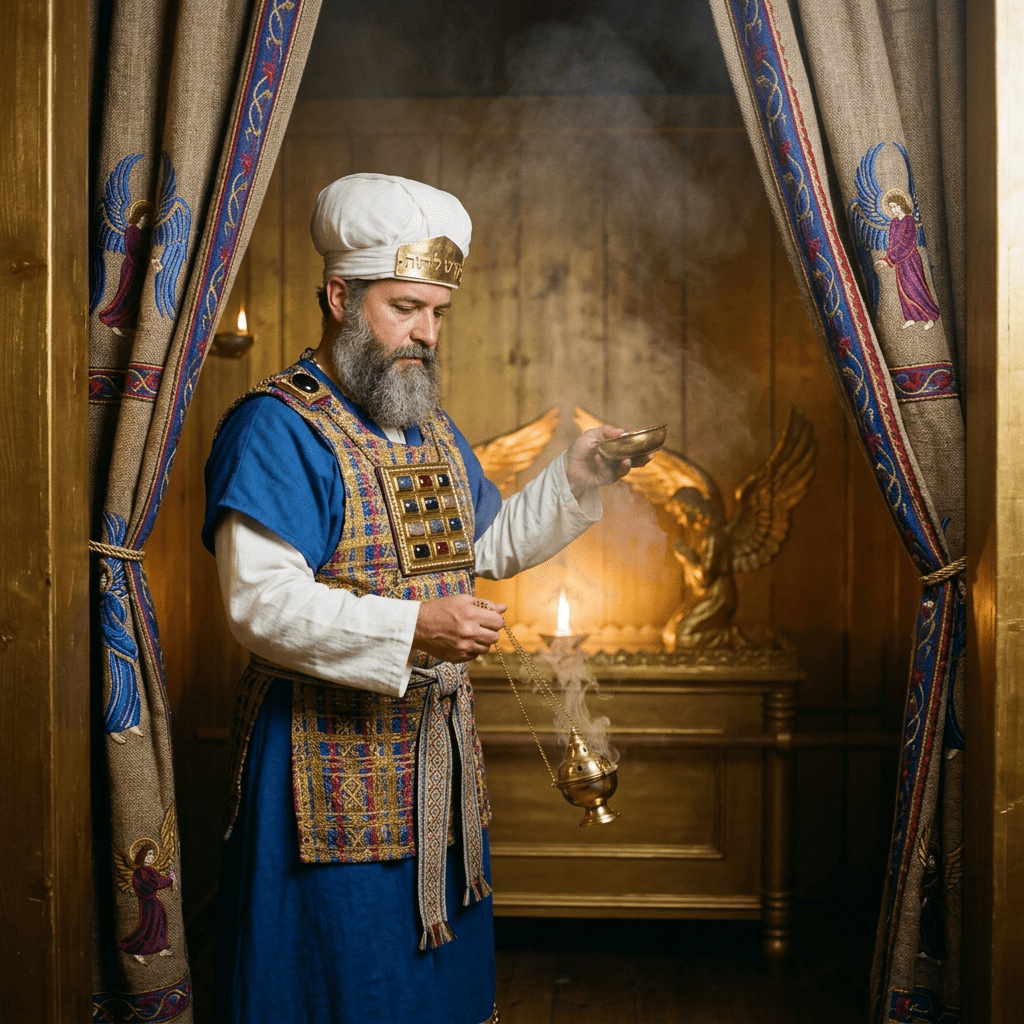
Acharei begins with instructions to Aaron after the tragic deaths of two of his sons.
Within the Portion, the important matter of sin atonement is addressed. Aaron, as High Priest, is instructed that “..he shall make atonement for the holy place of the Holy, and he shall make atonement for the Tent of the Meeting and for the altar, and he shall make atonement over the priests and over all the people of the community. And this shall become an eternal law for you, to make atonement over the Children of Israel from all their sins, once in the year.” Leviticus 16:33. [emphasis added] [Note: In modernity, the annual event has become the High Holiday Yom Kippur.]
Theologically, the Children of Israel had their representation to their Deity assigned by the Deity. Prior to Acharei, the priestly designation had been made to Aaron and his sons. [Note: “And they shall have priesthood as an eternal law. Exodus 29:9]
This generational designation essentially locked in successors. Later on, it would be refined even further. Phinehas, Aaron’s grandson, would receive the covenant of eternal priesthood; the rationale being that because “he was jealous for his God, and he made atonement for the Children of Israel.” Numbers 25:12-13.
With this measure, cultic leadership was locked eternally into a particular bloodline. Despite their divine designation, their burden was be a representative of the people towards the Israelite Deity.
Moses’ representative status, compared to Aaron’s priestly designation, however, was far more complicated.
Moses
Moses’ emergence as an Israelite Leader is from divine origins. His ascendancy occurred at the Mt. Sinai Burning Bush theophany.
With this Israelite Deity encounter, Moses is charged with the following: “And now go, and I’ll send you to Pharaoh and bring out my people, the Children of Israel, from Egypt.” Exodus 3:10.
When Moses returned to Egypt, he did so only with divine bonafides. His relationship to the Children of Israel would eventually be formalized at Mt. Sinai.
At the Mt. Sinai Ten Commandments’ theophany- at a time of the sound of horns, thunder and a smoking mountain- the Children of Israel requested of Moses “[y]ou speak with us so we may listen, but let God not speak with us or else we’ll die.” Exodus 20:18-19. With that, Moses was unanimously elected by the people as their intermediary. At that point, he was truly recognized as a prophet.
The Balancing Act
Moses’ election by both parties made his handling the Israelite-Deity relationship tenuous.
Moses’ balancing act between Deity and subjects reached fever pitch with the Golden Calf incident. In confronting the Lord over the decision to eradicate the Children of Israel, Moses, in fully embracing his Israelite representative role, pleaded with God: “And now, if you will bear their sin– and if not, wipe me out from your scroll that you’ve written.” Exodus 32:32. With that moment, Moses proved his devotion to his role as the Children of Israel’s representative.
Moses, in turn, addressed representation within the Israelite judicial system.
The Judiciary
With respect to disputes, Moses needed to find individuals to judge. He was directed by his father-in-law Jethro to find “worthy men, who fear God, men of truth, who hate bribery, and you’ll set chiefs of thousands, chiefs of hundreds, chiefs of fifties, and chiefs of tens over them.” Exodus 18:21.
Unlike other designations, a judge’s position was based upon qualification and not generation in nature.
Beyond the judiciary, the Torah also installed a monarchical blueprint within the Book of Deuteronomy.
The Monarchical Blueprint
In Deuteronomy, the framework was laid out for the election to ratify a monarchical governmental.
While there would be rules governing such a monarch, there was also a decision process laid out as to who would become king. “When you’ll come to the land that the Lord, your God, is giving you, and you’ll take possession of it and live in it, and you’ll say, ‘Let me set a king over me like all the nations that are around me,’ you shall set a king over you whom the Lord your God, will choose! You shall set a king from among your brothers over you.” Deuteronomy 17:14-15.
After a period of time documented in the Book of Judges, the Israelite Tribes finally made a decision with respect to their governance structure.
The Monarchical Election
After the period of the Judges, it would be the Prophet Samuel who would install the Israelite Monarchy. This occurred when the prospects for the Prophet’s replacement was dim. 1 Samuel 9:1-3.
In this instance, the Israelite Elders acted upon this matter. They told Samuel: “Behold, you are old, and your sons did not follow your ways. So now appoint for us a king to judge us, like all the nations.” 1 Samuel 8:5.
With the acceptance of this provision, it came with consequences. Beyond the monarchical demand for provisions and labor, they were forewarned that “On that day you will cry out because of your king who you have chosen for yourselves — but the Lord will not answer you on that day.” 1 Samuel 8:18. [referring to the protocol for the king and their entitlements. 1 Samuel 8:10-17.] Despite the warning, the Elders demanded a king.
In the end, the Lord directed Samuel to crown a king for them. 1 Samuel 8:22.
With that, Samuel eventually anointed Saul as King. After Saul fell out of favor, it was Samuel, at the behest of the Lord, who then anointed David as King. 1 Samuel 16:12-13. With David’s success, the selection of the successor king became a familial event with the Davidic covenant.
The Davidic Covenant
The Israelite Deity employed Prophets to contact his appointments and designations. The Prophet Samuel anointed both Saul and David as Israelite Kings. It would be the Prophet Nathan who would take the Davidic Monarchy and transform it into the House of David.
David is told by Nathan that “Your dynasty and your kingdom will remain steadfast before you all time; your throne will remain firm forever.” 2 Samuel 16-17. These words were of the Lord that came to the Prophet Nathan.
The desire for familial-based representatives is not foreign in modernity. Political nepotism is quite common. In the United States, families such as the Kennedys and Bushs have had multiple members and generations hold public office. Name recognition and familiarity play some role with respect to choosing an individual for representation.
Conclusion
Essentially, at Mt. Sinai, the Children of Israel’s acceptance of the Ten Commandments’ covenant empowered the Israelite Deity essentially to function as their Chief Executive Officer.
With that power, in Acharei, the Israelite Deity designated the High Priest who would represent the people on the important matters such as atonement. Whether such a representation arrangement makes sense is something worthy of debate. Whether representing people via an appointment is effective is questionable. For those interested in seeing the remnant of the Portion Acharei, it occurs in the High Holiday liturgy. The Hineini is chanted by the Cantor. They assume the role as the congregation’s representative.
Within the Deity’s executive powers, he would also employ his Prophets- i.e. Moses, Samuel and Nathan- to conduct appointments, anointments, and address the position’s terms.
The choice of Prophet also appears to be challenging within scripture. For instance, neither Moses’ or Samuel’s children ascending to the designation of Prophet. Further, from the human standpoint, determining a Prophet’s authenticity is challenging if not impossible.
While eternal assignments to positions of power is odd, it does however fit within a larger Israelite framework. While the tact is exclusionary, it also comports with the Jubilee Laws which assigned unique powers to the landowners and their inheritance rights.
The land-owning populace received eternal benefits and protections within the system. For instance, when King Ahab desired a commoner’s property, the commoner Naboth felt comfortable indicating to the monarch that the Lord forbid him from giving away the inheritance of his ancestors. 1 Kings 21.
The takeaway is the eternal assignments had some logic attached to them within the Israelite system for some participants. Whether it has any modern relevancy this any relevance is questionable.
While the concept of Prophets charged with making Deity-based assignments is problematic due to verification, an Executive assigning representatives to positions has modern utility.
Likewise, for those with assigned representative powers, a protocol setting limits to power also is a valuable concept in present times.
Likewise, the existence of inalienable rights-i.e. Jubilee laws, is also something that has utility in the present.
Finally, specifically with respect to Acharei, the notion that representatives should take on the role of addressing the needs to the entire community remains something of import.
Finally, representation’s favorability can be measured historically. While Moses was chosen by the Deity initially, he was then chosen by the Children of Israel to be their Prophet. In contrast Aaron and his successors’ cultic representation for atonement for the congregation was not as a result of the people’s election. Further, after the Golden Calf incident, Moses’ representation of the people to the Lord in seeking atonement on another level earned him eternal gratitude and respect.
Thus, in modernity, the favorable opinion of Moses as a people’s representative versus Aaron and his progeny is completely understandable.
Please like, follow, comment or share.


One thought on “Acharei: On Representation”