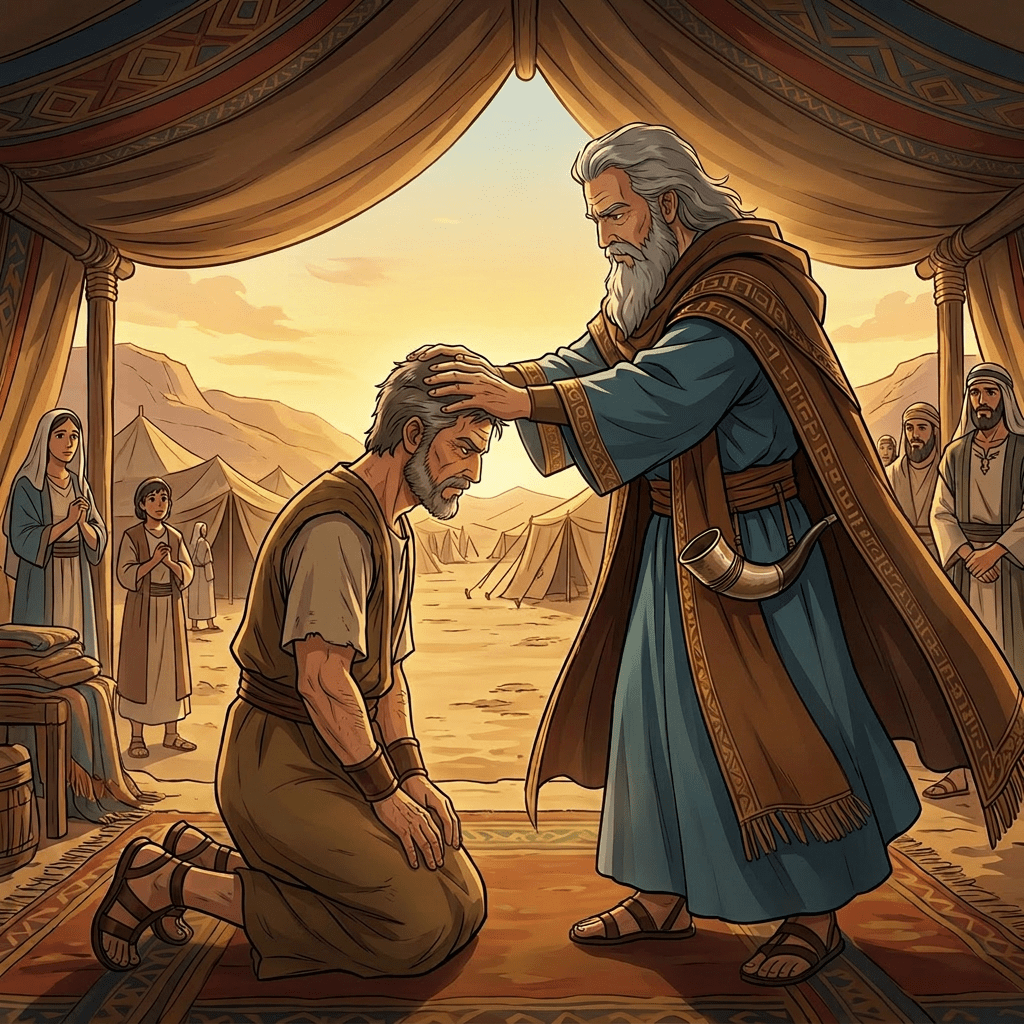
It takes a visionary who explores the past, the present, and the future to fill top executive positions. God, in the Torah Portion Phinehas, offers up a Master Class on hiring practices. In the portion, he has the daunting task of replacing both his Prophet- national leader- as well as his High Priest- religious leader. In the Portion Phinehas, Moses’ and Aaron’s successors are named.
The Decision Process
Each position- Prophet and Priest- required different capabilities. Thus, a one size fits all approach to these hires was impossible. Both flexibility and continuity were embraced in the decision-making process. In the end, scripture indicates that both choices were outstanding.
In order to appreciate the choices, some background is necessary.
The Background
A leadership failure occurring in the Torah Portion Chukat caused created the vacancies. Both Moses’ and Aaron’s services were terminated as a result of Moses defying God’s instruction to talk to a rock to get water. Instead of talking to the rock, he struck it with his staff two times. See Numbers 20: 9-12. The Portion Chukat tells that Moses’ defiant act against God was done in front of the community.
Thought Process
As this post reveals, God’s replacement thought processes in hiring practices still resonates today. Factors such as continuity, mentorship, character traits, meritocracy, social profile, nepotism, and politics were all considerations in the decisions.
The Torah Portion’s first replacement for Aaron, the High Priest would be the most complicated; Aaron has passed away and the position was already filled.
The Art of the Offer
Sometimes, a hiring decision needs to be special. This was the case with the choice of priest.
The position of High Priest was an opaque in terms of the public. Unlike Moses’ Prophet position, a High Priest’s comings and goings within ritual practices are things not fully understood or observed by the public. In filing the position, an incident in the Torah Portion Balak gave Phinehas a high profile within the Children of Israel. His dramatic act to address a ritual violation was so favorably viewed by God that it stopped a plague. Thus, the public new that he was quite capable of engaging in the priestly task of seeking atonement.
To land Phinehas in the top slot, God made a big splash; Phinehas’ deal was one you can’t refuse; one in perpetuity. The fact it came from God, and not the Godfather, made it even better.
This act served two purposes. It strengthened the institution and attempted to reduce priesthood politics.
The offer, however, was complicated in that Aaron had already passed away and the position was filled.
[Note: Phinehas’ priestly installment was evoked in a post-Hebrew Bible history during the Hasmonean revolt. Without Phinehas, Hannukah may never have happened.]
Phinehas
Replacing Aaron was a tricky issue as he already had been replaced upon his death. Phinehas’ father Eleazar was installed as the high priest. See Numbers 20:28. Despite this promotion, God tabbed Phinehas for the priesthood position. Despite Phinehas’ promotion, he would have to wait. Eleazar would continue in the priestly role until passing. At that point, Phinehas would take over the role. See Joshua 22
The Torah Portion begins with the dramatics of Phinehas’s promotion. His zealous act captured within the Torah Portion Balak won over God’s favor. See Numbers 25:6-9.
The Portion Phinehas then moves towards his promotion: “Phinehas son of Eleazar son of Aaron, the priest, has turned back my fury from the Children of Israel by his carrying out my jealousy. Therefore say: Here, I’m giving him my covenant of peace, and it shall be his, and his seeds after him, a covenant of eternal priesthood, because he was jealous for his God, and he made atonement for the Children of Israel.” Numbers 25:10-13.
Phinehas’ act the cessation of a plague was witnesses by all of the eyes of the congregation. Numbers 25:6. Richard Elliott Friedman in Commentary on the Torah notes that Phinehas’ actions addressed a ritual offense; the individuals involved in the incident were in an area not permitted for non-Levites. See P. 513.
In the moment, God revealed part of his rationale for the hire. Phinehas’ well-known act gave him a high profile within the public. In modernity, decorated military leaders are often considered candidates to lead their respective countries.
With Phinehas being elevated to control the priesthood, the Torah Portion turns to Moses’ successor- Joshua.
Joshua
Post-Exodus, Joshua played a major role in assisting Moses. With respect to military service, he defeated Amalek, See Exodus 17:13, at Mt. Sinai, he served as Moses’ attendant, See Exodus 24:13, and with respect to the Portion Shalach’s Promised Land Scouting Mission, he and Caleb proved to be the only upright individuals involved in the debacle.
In the Portion Phinehas, Joshua’s promotion took place as follows: “And Moses spoke to the Lord, saying, ‘Let the Lord, God of the spirits of all flesh appoint a man over the congregation who will go out in front of the and who will come in in front of them and who will bring them out and who will bring them in, so the Lord’s congregation won’t be like sheep that don’t have a shepherd.” Numbers 27:15-17.
God’s choice was Joshua son of Nun. He was from the tribe of Ephraim. He was not a Levite like Moses.
Upon the Lord’s direction, it is told: “And Moses did as the Lord commanded him, and he took Joshua and stood him in front of Eleazar, the priest, and in front of the congregation. And he laid his hands on him and commanded him, as the Lord had spoken by Moses’ hand.” Numbers 27:22-23.
The choices differed. One position remained familial while the other placement went to another tribe.
God’s rational for the hire was slightly different. He viewed Joshua as having leadership qualities as opposed any particular past achievement. Rather, he had built of a record of achievement. The emphasis that he had the abilities to perform the task of shepherding the congregation.
Both Phinehas’ and Joshua’s hires involved additional issues such as matters of nepotism and meritocracy.
Tribal Nepotism vs. Merit
Nepotism was enveloped within the Israelite nation’s composition. Certainly, tension arose from this. Leadership, at the time of the Exodus, was Levite tribe top-heavy; siblings Moses, Aaron and Miriam controlled.
The tribal structuring set the Levites apart from the other times. At that point in time, the Levites were responsible for the cult. As part of the structure, their land ownership rights would differ from the other tribes.
Beginning with Abraham, the nation’s father, family tensions existed with respect to family leadership. In connection with the covenant, Abraham was forced to break up his family; Isaac was chose rather than Ishmael to be the successor. With Isaac, Jacob’s theft of Esau’s birthright brought family unrest to a fever pitch. With Jacob winning out, and his large amount of sons, the single family became tribal units. The tension remained but arguably the intensity dissipated.
Eventually, merit would begin to play a role. Joseph won over his brothers with his Egyptian achievements. Despite this, however, the Israelite leadership for the Exodus came from the Levite Tribe with Moses and Aaron.
In the case of Phinehas, he stood out as a leader from his family for his act in the Portion Balak. For Joshua, he earned merit for engaging in a multitude of tasks to assist both Moses and the Israelites. Thus, God- using vision of the past, present and future- did not employ a singular formula.
Political Considerations
In the portion, political considerations were made. Given that the Israelite nation consisted of a loose tribal confederation, and that the priestly class was designated to the Levite Tribe, having both Prophet and Priest positions with one tribe was problematic.
Joshua’s appointment arguably eliminated some tribal friction. He was from another tribe- Ephraim.
For the priesthood, his decision was to stay within the Levite Tribe with someone who had displayed the capacity to do the job. For the role of Prophet, he took Joshua, a non-Levite, who had the qualities to perform the task at hand.
Modernity
In modernity, United States Supreme Court appointments involve similar issues to that involved with the Torah Portion Phinehas. Judges are awarded lifetime positions. Thus, the United States President must be a visionary when the selection made. The candidate’s past and present must be understood to gain a vision as to how the individual will impact the court.
Given the Justice position’s demands, considerations include the following: bench experience, one’s legal community profile, their public notoriety, their judicial competence, their ideology, their age and their demographics.
Conclusion
The challenge to replace prominent leader was met in the Torah Portion Phinehas. It was done by applying vision into the past, present and future. In filling the top executive positions, a multi-factorial approach was used. The candidates’ qualifications such as leadership skills, political reception, past experience, public profile and familial relations were all considered.
Likewise, special qualities such as include zeal and spirit proved important. Also, an individual’s familiarity with the workforce proved essential. Both Phinehas and Joshua were well-known entities to the Israelite congregation for their accomplishments. Thus, their selections came of no surprise to the Israelite nation.
In the case of Phinehas, his zealousness proved that he was capable of maintaining the priestly role’s dignity within the Israelite nation; he was one who had the ability successfully seek community atonement before the Israelite Deity.
The decision to give him a lifetime appointment perhaps was a desire to reduce future replacement controversies. Further, a side benefit of his having to wait for his position to open before filling it was that he had the opportunity to be mentored by his father Eleazar. This generational continuity eventually played a Post-Hebrew Bible role in sparking the Hasmonean Revolt against the Seleucid Greek occupation; zealousness mattered.
In Joshua’s case, he was essentially mentored by Moses. His subordinate experience included military service, assisting Moses at Mt. Sinai, and providing a shining light amid the Promised Land scouting mission controversy. With respect to the task of entering into the Promised Land, only he and Caleb, at the time of entry, would be the only individuals with past familiarity with the territory.
Beyond being well-known by the entire Israelite congregation, Joshua was likely chosen because he was neither a descendant of Moses or a fellow Levite. This rebalanced to top heavy Levite composition of the nation’s leadership.
In the end, a multitude of factors played a role in filling the sandals of two great leaders.
Be well!!
Please like, follow, comment or share
 The Ten Commandments Project
2 thoughts on “Phinehas: The Torah’s Executive MBA Program”