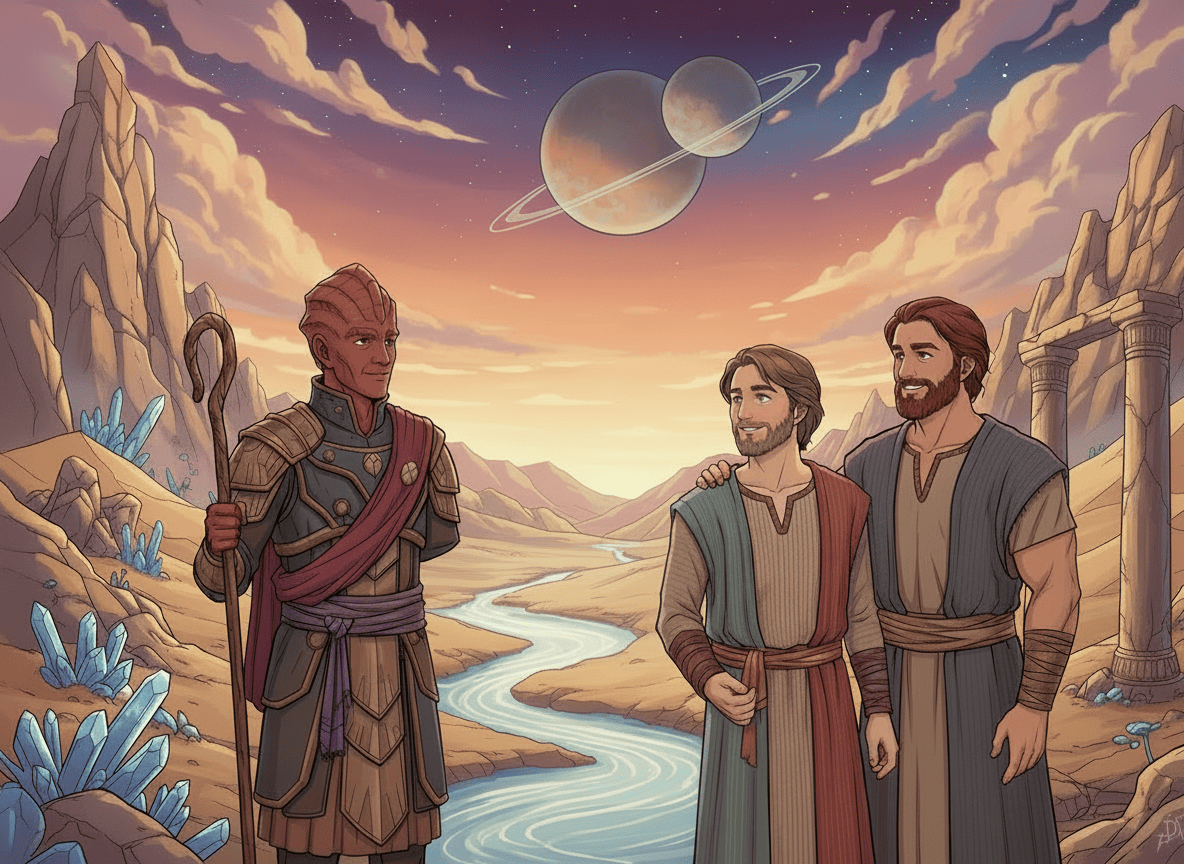
For Star Trek TNG fans, the phrase “Darmok and Jalad at Tenagra” is meaningful. To them, it rekindles their memory of a television episode that explored language and communication. In it, the Enterprise crew encountered an alien species- the Tamarians- for which their universal translator did not work. The problem was that the Tamarians’ language was full of allegories. To understand allegories, one must understand history. Thus, communicating in their language required knowledge of past stories and mythology.
Allegories being part of language is not alien. The English language includes many allegories or phrases; a number of them being biblical. For instance, “David and Goliath” is one of the most famous. It describes the situation in which a far lesser opponent either defeats or is to face off against a far greater opponent.
The Torah Portion Vayishlach also offers a famous allegory: “Jacob & Esau.” The Portion Vayishlach culminates the Jacob & Esau saga and gives it new meaning; a message of hope.
The Jacob & Esau Narrative
Jacob and Esau is the tale of two twin brothers. Their relationship was problematic even before they were born. The children struggled in the womb. Genesis 25:22. This struggle was so traumatic that their mother, Rebekah, queried the Lord. Genesis 25:22. A deeply concerned God answered her. He indicated that each of her children were to become a people; one would be mightier than the other. Genesis 25:23.
With their birth, the first one, Esau, came out hairy and ruddy and the other, Jacob, came out holding his brother’s heel. Genesis 25:24-26.
The brothers grew up as opposites. Esau was a hunter while Jacob was a tent dweller. While Esau was his father’s favorite, Jacob was his mother’s.
Rebekah, wanting Jacob to be the successor patriarch, intervenes. She gets Jacob, by deception to steal Isaac’s blessing. The blessing’s theft enraged Esau. Esau expressed intentions of killing Jacob upon his father’s passing. Genesis 27:41. In fear, Jacob fled for his safety to Haran. There he stayed with Rachel’s brother, Laban.
In Vayishlach, after having established a family and gained wealth, Jacob returned to the Promised Land. There, he would have to meet up with his brother. Jacob, fearing the worst, planned for the confrontation. With this plan, Jacob both sent gifts ahead to his brother and tactically arranged his family in case of a poor reception.
The Torah described Jacob as bowing to the ground seven times before he met his brother. “And Esau ran and embraced him and fell on his neck and kissed him. And they wept.” Genesis 33: 4-5.
The Meaning
Referencing Jacob & Esau is the ultimate allegory for brotherhood. Siblings, despite rivalry, can co-exist. Bad faith or questionable acts from the past can be forgiven. Each brother possessed their own agency to have successful and prosperous lives rather than stew in victimhood.
Conclusion
In the English language, Jacob & Esau is a powerful allegory concerning siblings. Despite past indiscretions and animosity, relationships can heal. The wrongs and misdeeds can be forgiven. The Torah Portion Vayishlach provides the climax to this allegory.
Be well!!
Please like, follow, comment or share


One thought on “Darmok and Jalad at Tenagra: Vayishlach’s Biblical Literacy Moment”