Did a priestly rivalry rear itself in the telling of the Chanukah story? Per academics, the Aaronids (Aaron’s descendants) and the Mushites (Moses’ descendants) jockeyed for priestly positions in scripture within Israelite tribes and monarchies. Scholars have gone so far to opine that their power struggle manifested itself within the Hebrew Bible stories. This particular rivalry was also on display within post-biblical literature. The Chanukah story, as told in The First Book of Maccabees, includes a blatant omission evidencing that Aaron’s descendants had a Moses problem. Did Hasmonean egos cause the omission of “the most humble man who ever lived” as an inspiration for the revolution? (See Numbers 12:3.)
To answer the question, the Chanukah tale’s events must be explored.
Chanukah’s Historical Literature
Chanukah celebrates a post-Hebrew Bible event commemorating the Hasmonean revolt against the Seleucids which led to the Second Temple’s rededication. A written account of the military campaign exists within The First Book of Maccabees.
Within the text, the Priest Mattathias led the revolt. Once taking power, various members of his family, the Hasmoneans, assumed the Second Temple’s High Priest position.
The High Priest position, scripturally, required lineal descendancy; those filling it were to be descendants of Phineas, Aaron’s grandson. (See Numbers 25:12-13: “Therefore say: Here, I’m giving him my covenant of peace, and it shall be his, and his seed’s after him, a covenant of eternal priesthood, because he was jealous for his God, and he made atonement for the Children of Israel.”)
Thus, with the Hasmoneans taking control and their assuming the Temple’s High Priest position, they necessarily aligned themselves with the Aaronids. Regardless of whether they were truly Phineas’ descendants or not is irrelevant, this was necessary for their legitimacy to hold the position.
Given this background and position, it is opined that The First Book of Maccabees was crafted in a manner that was pro-Aaron.
The Passage of Interest
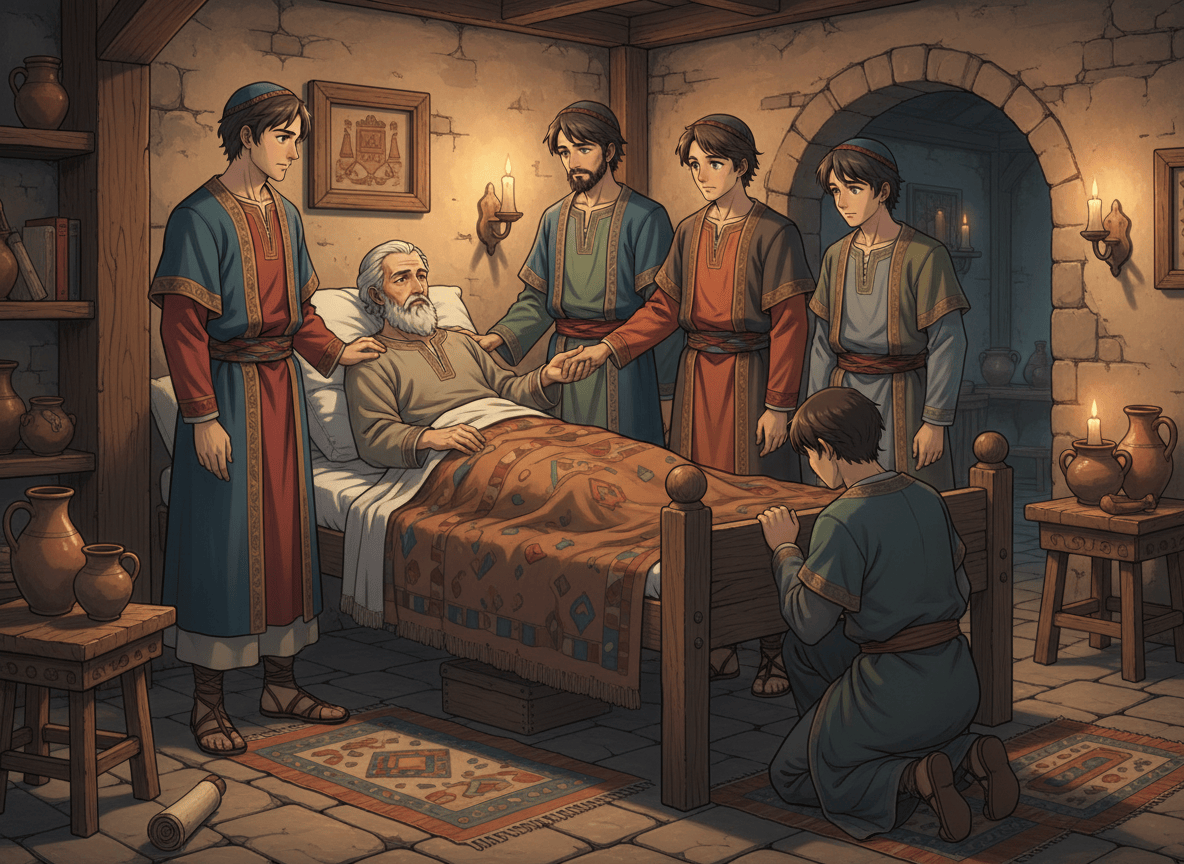
The passage of interest concerns Mattathias. He is both a Priest and the revolt instigator against the Seleucids. Mattathias’ deathbed speech contains a passage evidencing the priestly rivalry. Either Mattathias, himself, or The First Book of Maccabees‘ author omitted Moses as being an inspirational source for the revolution. Was this due to the rivalry?
Mattathias’ Deathbed Speech
While on his deathbed, Mattathias tells his sons. “Arrogance and scorn have now become strong; it is a time of ruin and furious anger. Now, my children, show zeal for the law, and give your lives for the covenant of our ancestors.” First Book of Maccabees 2:49-50.
Mattathias goes on further: “Remember the deeds of the ancestors, which they did in their generations; and you will receive great honor and an everlasting name. Was not Abraham found faithful when testing, and it was reckoned to him as righteousness? Joseph in the time of his distress kept the commandment, and became lord of Egypt. Phineas, our ancestor, because he was deeply zealous received the covenant of everlasting priesthood. Joshua, because he fulfilled the command, became a judge in Israel. Caleb, because he testified in the assembly, received an inheritance of land. David, because he was merciful, inherited the throne of the kingdom forever. Elijah, because of great zeal for the law, was taken up into heaven. Hananiah, Azariah, and Mishael believed and were saved from flames. Daniel, because of his innocence, was delivered from the mouths of lions.” First Book of Macabees 2:51-60. (Note: In the Jewish Annotated Apocrypha (NRSV) Commentary on this passage, it is noted that the Hasmoneans were termed Phineas’ ancestors because by the time the book had become composed, they had become the high priests- “a position reserved for Phineas’ descendants.” See Page 213.)
In this rousing speech, Mattathias omitted Moses. When analyzed chronologically speaking, this was clearly an omission and not a mistake.
Missing Moses
Chronologically, Moses would have fit between Joseph and both Joshua and Caleb. Moses, in his lifetime, exhibited zealousness for the Lord.
The intentional omission is further buttressed by an earlier speech by Mattathias. His words uniquely parallel those of Moses.
The omission’s intent can be further proven by Mattathias’ earlier words.
Mattathias’ Moses Moment
In the moment sparking the Hasmonean Revolt, Mattathias cried out: “Let every one who is zealous for the law and supports the covenant come out with me!” First Book of Maccabees 2:27.
This battle cry uniquely mirrors a Pentateuch passage. Moses, in rallying the people to his side, called out: “Whoever is for the Lord, come to me.” Exodus 32:26.
While Mattathias, or Maccabee’s authors, felt comfortable in paraphrasing Moses’ rallying call, they, however, felt uncomfortable with explaining the passage’s source and as to what made Moses zealous. There is a reason. Moses’ moment of zealousness came at a time when his brother Aaron failed.
The Golden Calf Problem
The Torah’s Golden Calf scandal was very problematic to the Hasmoneans. Moses’ peak zealousness occurred during the Golden Calf incident. Aaron, who was involved with the calf’s creation, was to blame concerning the debacle.
While within scholarship, the Golden Calf story’s attribution is controversial, it is undeniable that it placed a blemish on Aaron’s legacy. Thus, if Mattathias would have evoked Moses his peak zealousness moment, it would have been done at the expense of Aaron’s legacy. A reminder of Aaron’s career low point.
Great Egos
Thus, the crafting of The First Book of Maccabees required some sensitivity towards the leadership at the time. Any telling of Moses’ zealous and inspiring leadership would come at a cost for the Hasmoneans as they clung to the belief or reality of their Aaronid roots. Recounting Moses’ exploits would have placed a damper on Aaron’s legacy as it would recount the Golden Calf Incident. Arguably, the academically opined rivalry’s legacy, the Golden Calf story, presented as embarrassing to the incoming Hasmonean High Priests. Thus, they found that the removal of Moses as inspirational source served their interests.
Conclusion
With the Second Temple’s re-dedication, the Hasmoneans would eventually assume the High Priest position. Scripturally, Phineas, Aaron’s grandson, held the covenant with God that his descendants would eternally hold that position. Thus, the Hasmoneans either were or claimed to be descendants of Phineas. Moses, being on the list of biblical figures exhibiting zealousness to inspire the revolt, became problematic because it implicated Aaron’s failing, Moses’ moment of zealousness, which was arguably channeled by Mattathias when he initiated the revolt, was clearly not something that was complementary of the Aaronid Priests. Moses’ moment of zeal occurred during the Golden Calf crisis which evidence incident Aaron’s leadership fail. Thus, its reference was problematic. The omission arguably displays a keen awareness of either Mattathias or the author of The First Book of Maccabees.
Be well!!
Please like, follow, comment or share

