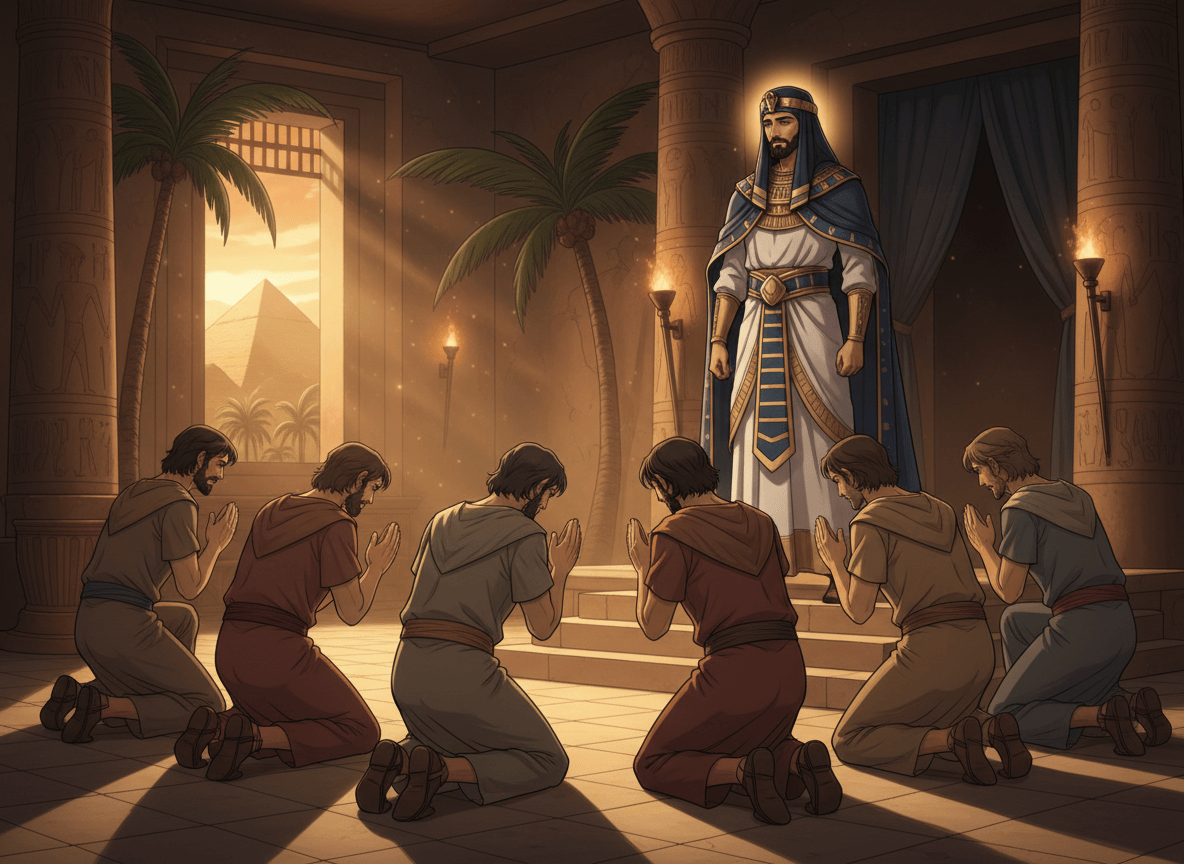
While the Torah Portion Vayechi offers up an example of child honoring his parents’ moment in accordance with the Ten Commandments, the very same passage elicits a theological dilemma that has forever troubled Judaism. Joseph’s brothers’ fears become reality when their father Jacob died. Their wronged brother, Joseph, Egypt’s second-in-charge, is positioned to exact revenge for them for getting him enslaved.
These type of moments have been captured in both literature and movies. Most notably, Fredo from the Godfather movies come to mind.
Fredo Syndrome
Joseph’s brothers perhaps felt like Fredo from the Oscar winning movie “The Godfather Part II.” In the film, Michael Corleone- the Godfather- shelved his desire for vengeance against his older brother Fredo until their last surviving parent- their mother- passed. Once she passed, Fredo had an unfortunate boating accident. As a result, he swam with the fishes.
Perhaps Joseph’s brothers feared Fredo’s fate; for them, a boat ride down the Nile could result in them inside of crocodile bellies. Fortunately for Joseph’s brothers, Jacob- their father- provided them some words to pass along to Joseph. This, and the fact that Joseph followed the spirit of the Ten Commandments, allowed the brothers to avert any controversy. (Note: This incident predated the Decalogue. Joseph was operating on pre-Decalogue belief system. One, that we know, included a prohibition against .)
To understand Vayechi’s commandment connection and the theological dilemma, the text is necessary.
The Vayechi Text
The Torah Portion Vayechi passage of interest is as follows:
“And Joseph’s brothers saw that their father was dead, and they said, ‘If Joseph will despise us, he’ll pay us back all the bad that we dealt to him.’ And they commanded to Joseph, saying, ‘Your father had commanded before his death, saying, ‘You shall say this to Joseph: Please, bear your brothers’ offense and their sin, because they dealt you bad.’ And now bear the offense of servant’s of your father’s God.”
Joseph responded to them as follows:
“And Joseph wept when they spoke to him. And his brothers also went and fell in front of him and said, ‘Here, we’re yours as slaves.’ And Joseph said to them, ‘Don’t be afraid, because am I in God’s place? And you thought bad against me. God thought for good: in order to do as it is today, to keep alive a numerous people. And now, don’t be afraid. I’ll provide for you and your infants.’ And he spoke on their heart.” Genesis 50:14:21.
Honoring Your Mother and Father
While being merciful to one’s siblings is certainly something admirable and appreciated by parents, the Vayechi passage adds another layer to the mix. Joseph’s brothers, in approaching him, also brought with them their father’s words; their father’s plea that Joseph take mercy upon them. In adding their father’s words, Joseph’s action did not require introspection. He did not have to assume that making peace with his brothers was his father’s wish. Rather, there was a parental instruction to be merciful.
Thus, this fact pattern brings up the issue of how should a child honor their parents when they are unaware of their parents’ wishes. Sometimes, however, children are not afforded their parents’ directions as to their interactions with siblings. Those circumstances lead an individual to have to imagine what conduct would have honored their parents.
Beyond this quandry, Joseph’s response to his brothers raises another. he brings up that there was something good that arose out of his becoming a slave. This comment raises an important theological dilemma that will be played out in the Book of Exodus.
The Theological Dilemma of Good Arising from Bad
Theologically, the Vayechi passage is problematic. In Joseph’s instance, the bad that happened to him was as follows: he was enslaved, he was tempted to engage in adultery, he was subjected to sexual harassment, he was humiliated, he was falsely accused of a crime, and he was imprisoned for a crime he did not commit.
While the bad leading to good for Joseph involved one individual, the Torah later tells of the Children of Israel’s Egyptian Bondage. This experience included the Pharoah commanding that every Hebrew son be thrown into the Nile. Exodus 1:22. Thus, with the Exodus, the Pentateuch raised the stakes with the concept of bad to a collective bad that included the loss of innocent lives. The resulting good was that they were able to leave their house of bondage as a numerous people. The quandry is: “t what cost?”
Thus, the concept of good arising out of something bad as being a divine plan theologically challenges the faith of many. This philosophical concept can be applied to many post-scripture events. Thus this passage is of import as it is this theology’s seed.
Conclusion
While the Torah Portion Vayechi addresses honoring a deceased parent, the fact pattern eliminated the need for the child to speculate as to their parent’s wishes. Jacob, the parent, knowing of the impending problem, provided his concerned sons a message to provide to Joseph. Jacob requested that Joseph take mercy upon them. Thus, Joseph’s decision to bury the hatchet with his brothers was not something that required Joseph to speculate as to his father’s wishes. There are times, however, when a child not knowing his parents’ wishes, may have to envision what actions would honor their parents.
Theologically, the Vayechi passage is one that is troubling to the faith of many. The concept that a divine plan can exist in which good arising out of bad circumstances is challenging to many’s faith. This theological challenge even grows within the Torah; Joseph’s experience would be considered as minor compared to what would become of the Children of Israel once in Egypt. The loss of innocents lives must be reconciled.
Please like, follow, comment or share


One thought on “Vayechi’s Ten Commandments and Theological Moment”