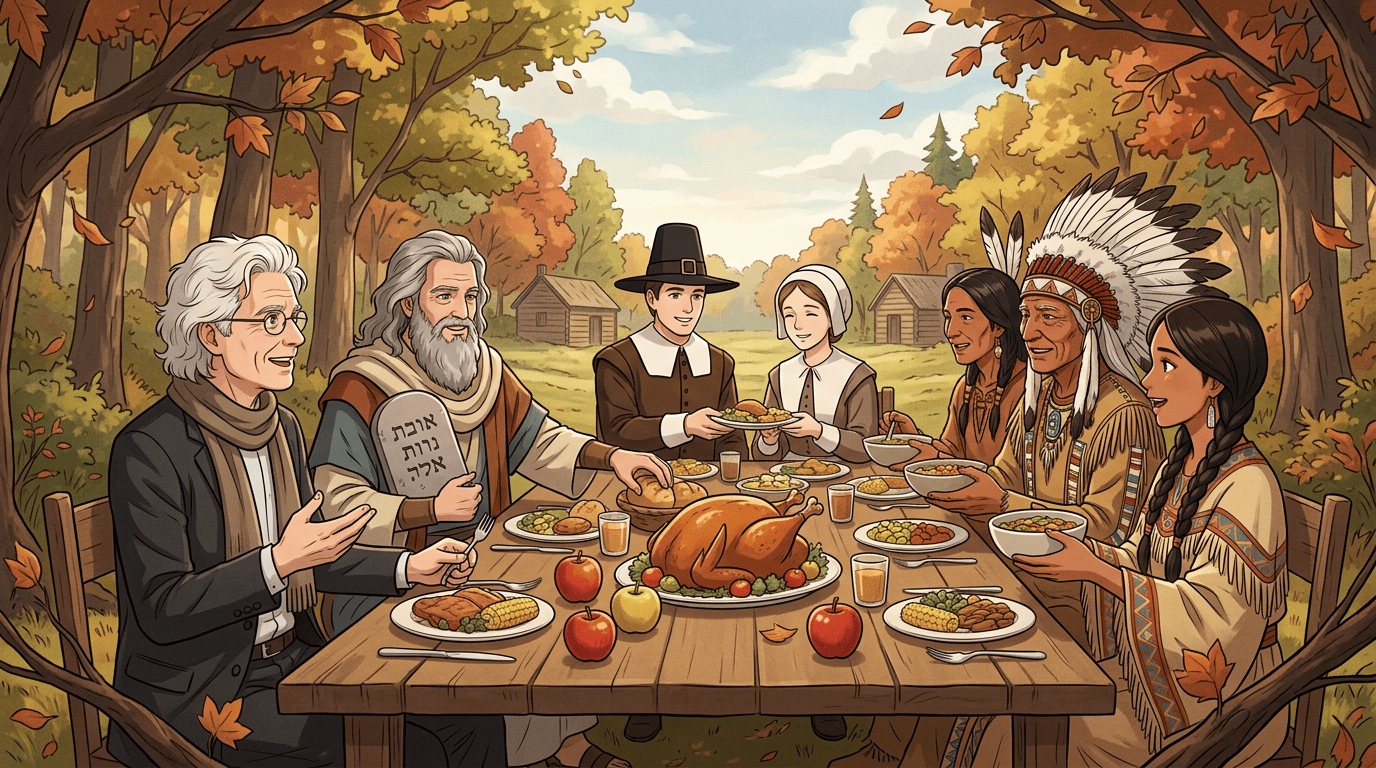
The renowned Cognitive Scientist Dr. Steven Pinker should perhaps author a book entitled: Gastronomic Knowledge: I know what you ate, you know what I ate, and you know that I know what you ate.
Food, throughout history, is a tool that societies employed to create common knowledge. Not the ordinary common knowledge- the things that everybody should know- but rather the common knowledge that is essentially known by all and all know that others know it. See Pinker, S. (2025). When Everyone Knows That Everyone Knows…: Common Knowledge and the Mysteries of Money, Power, and Everyday Life. Thus, common knowledge can be the collective knowledge that everyone is enjoying a holiday that includes a lavish meal. These inclusive acts often can impart societal values such as fellowship and gratitude.
To make such a gastronomic event successful, certain aspects must be followed. For instance, the societal meal should be something that the entire population shares en masse. In doing so, the event becomes common knowledge. It becomes a shared societal moment. People of all ages, nationalities, religious affiliations, wealth, and health have a common experience.
One of these gastronomic event’s blueprints is in Torah Portion Bo. Bo details the Passover meal. Given that the Passover meal is an event still practiced despite its ancient origins, it is worthy of study and comparison to a current gastronomic event- Thanksgiving.
The Torah Portion Bo
In the Portion Bo, the Passover meal was established to be an eternal event. Exodus 12:24. The Pentateuch describes the event’s specific details. It was to take place on a date certain; Exodus 12:3; the centerpiece food item was specific; Exodus 12:3; (Lamb); it was specified to be a household(family) event; Exodus 12:3 (Fathers’ house); neighborly distribution of the centerpiece food was a concern; Exodus 12:4; there was some signage involved; Exodus 12:7 (The blood of the lamb on doorposts and lintel); it was to be at time certain- night. Exodus 12:8; it was to be served with sides in a particular fashion; Exodus 12:8 (unleavened bread and bitter herbs.); Exodus 12:8. There were to be no leftovers and it was to be eaten in a certain fashion- hips clothed, with shoes on and holding a staff; and the meal was to be eaten in haste. Exodus 12:11. Also, the celebration, for all intents and purposes, was intended to be celebrated by all. Exodus 12:43-49 (Note: there were some limitations pertaining to the uncircumcised.)
While the Passover meal has extensive dictated particulars, the American Thanksgiving Holiday. Thus, it is of interest to see if they vary in any fashion.
Thanksgiving
In the United States, while the Thanksgiving Holiday is one without significant detailed legislation, it is one that is bolstered by tradition. The one important government factor is the date of the event. Being on a Thursday, the event becomes part of essentially a four-day holiday. Given that, it is a worthy time to travel; many families celebrate it together.
Beyond the extended time, the holiday, being one of giving thanks, has taken on a life of giving back to the community. The holiday is one of volunteering. People go out of their way to volunteer at soup kitchens to ensure that everyone- from all strata- residing in the country enjoy a traditional Thanksgiving meal.
Thus, a meal of Thanksgiving staples is warranted. Turkey, gravy, stuffing, and pumpkin pie are ones that everyone imagines that everyone eats. Some cranberry sauce is also indicated. Whipped cream on the pie? Debatable.
The holiday may also include some decorating. A cornucopia on one’s front door comes to mind.
Finally, the holiday meal is often eaten hastily in the afternoon so that the football games can be watched.
In sum, much of the Passover meal’s elements are part of Thanksgiving via tradition. Further, communal messages are passed on. For Thanksgiving, gratitude is the value being promoted. For the Passover meal, originally, the message was essentially salvation. Exodus 12:27 (…when your children will say to you, ‘What is this service to you?’ that you shall say, ‘It is the Passover sacrifice to the Lord, because He halted at the houses of the Children of Israel in Egypt when He struck Egypt, and He saved our homes.'”) It appears, regardless of written instructions, that given the opportunity, societies will make their best efforts to make communal holidays a success.
Conclusion
Beyond words, societies transmit messages in countless ways. One of them is through gastronomy; communal foods matter. This is evidenced not only in the past with the Passover meal but also in the present with Thanksgiving. While the two feasts have much in common, the only notable difference is that one’s details are written whereas the other is largely based upon tradition. Despite that, they have many similarities. People are both attracted to and are open to participating in such events.
Please like, follow, comment or share.


So good
NOTE NEW EMAIL ADDRESS: David@dasintl.com
LikeLike