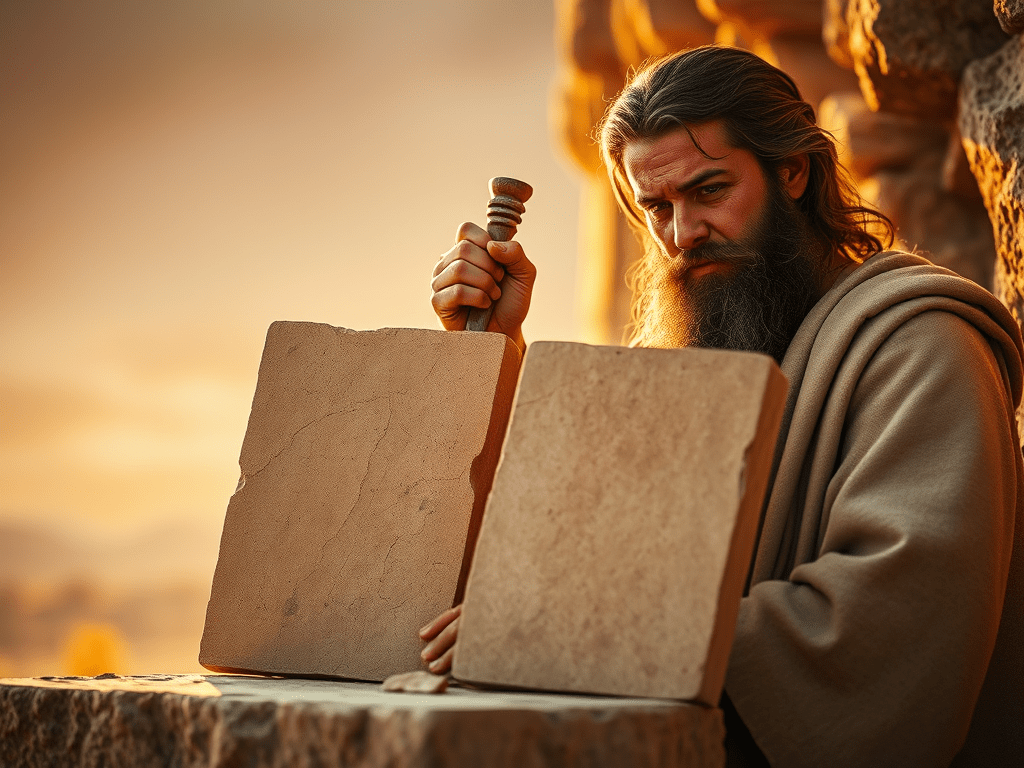
An epic Ten Commandments’ moment occurred in last Saturday’s Sukkot Torah Portion reading. While the entire Portion is an essential scriptural read (Exodus 33:12-34:26), there is one revealing Decalogue-related passage.
Words Alone?
Is the Ten Commandments just simply about the words? Or, is there something about the commandments that is beyond the words? The Sukkot passage will answer this question.
“Words” are not everything. Sometimes, a book can be all about its cover!
Essentially, context surrounding the words’ publication brings meaning and elucidation. As we shall see, in some circumstances, the medium upon which words have been inscribed offers meaning to the words.
As such, it is worthy to explore the pre-publication events and facts surrounding the publication matter. Ideas, concepts, and writing surfaces can enlighten readers about a publication’s context and meaning.
For example, the United States’ founding documents- the Declaration of Independence, the Constitution and the Bill of Rights- by themselves provide much understanding to those essential papers. Achives.gov
Absent reading the entirety of the compositions’ words, one can look see that these revolutionary documents are on unbound parchment and written in calligraphy.
Visually, some of the words are inscribed in attention getting large font. The Constitution’s massive “We The People” tells us something.
Thus, the physical documents themselves have the potentiality to provide insight into both the times and the publisher’s sensitivities.
Contextual Enlightenment
The same contextual analysis can be applied to the Ten Commandments. The Sukkot Torah Portion provides an illuminating line:
“and the Lord said to Moses, “Carve two tablets of stone like the first ones, and I’ll write on the tablets the words that were on the first tablets, which you shattered.” Exodus 34:1
This passage tells us much about the Ten Commandments.
First, it describes a publishing partnership between the Deity and Humanity. God tells Moses to carve the stone tablets. Upon completion, it is the Lord was to take over the creation process.
Second, the stone medium for publication is telling. Stone is something that was part of the Lord’s creation. Thus, absent the writing- God’s scribal work- the document is quite worldly.
Third, there are “two” tablets of stone. What does it mean? Why isn’t there just one?
While there are those who separate the top five commandments from the bottom five based upon the notion that the first set involves God-Man matters while the bottom are Man-Man matters, it is contended that there is a simpler explanation.
Rather, it if contended that the two tablets are a function of reality. With stone carving, only so many words could be placed upon a single tablet. Thus, two were needed to place all of the Decalogue’s contents.
This notion is consistent with the future portions of the Hebrew Bible. Humanity, at times, is constrained by the world’s physical capacities. Thus, scroll length influenced the Bible’s construction. For instance the Book of Samuel exceeded the maximal scroll length at the time. Thus, it was divided into two parts.
Third, there is the notion of stone as the material. Stone is permanent. This was chosen versus parchment, clay, papyrus and other writing surfaces. Precious metals were also not involved. The Decalogue could have been written on silver or gold. This is well within the realm of possibility.
One early writing discovered was the Ketef Hinnom. This tiny silver scroll contained the priestly blessing. Copper was also employed in the past. This material was used to publish one of the Dead Sea scrolls. Using a precious material, in this circumstance, however, would also place the document in a vulnerable position. It would have put it at risk for being damaged in fire. Also, the tablets’ material could have been valued more than the words. thus and place it at risk of being melted down for its raw material.
Fourth, there is the inscription upon the stones. The spectacular aspect of these Ten Commandments was that the Lord was the scribe. This fact elevated the objects to be priceless.
Fifth, the content was to be a duplication of the past. This is a reflection as to the solid nature of the words. Despite the Golden Calf incident, these words still applied. Thus, the present the timeless character of what was set in stone.
Sixth, the parting jibe. What was the Lord’s intent in reminding Moses that he broke the first set? Was it for guilt? Was it possibly for humor? Surely, any parent can be envisioned is a discourse to land a “Don’t break it this time!”
Conclusion
Thus, there is much that we can know about the Decalogue absent the content. There are expressions of partnership between Deity and humanity. There are the notions of the physical realities of the world via the necessity for two tablets. Further, there is the notion of the intent of document’s permanence. Finally, the tale surrounding the second set of the Decalogue. It can be construed as an attempt to assign guilt or provide sarcastic comic relief.
Be well!!
Please like, follow, share or comment
 The Ten Commandments Project
2 thoughts on “A Very Ten Commandments’ Moment: This Sukkot’s Saturday Torah Portion”