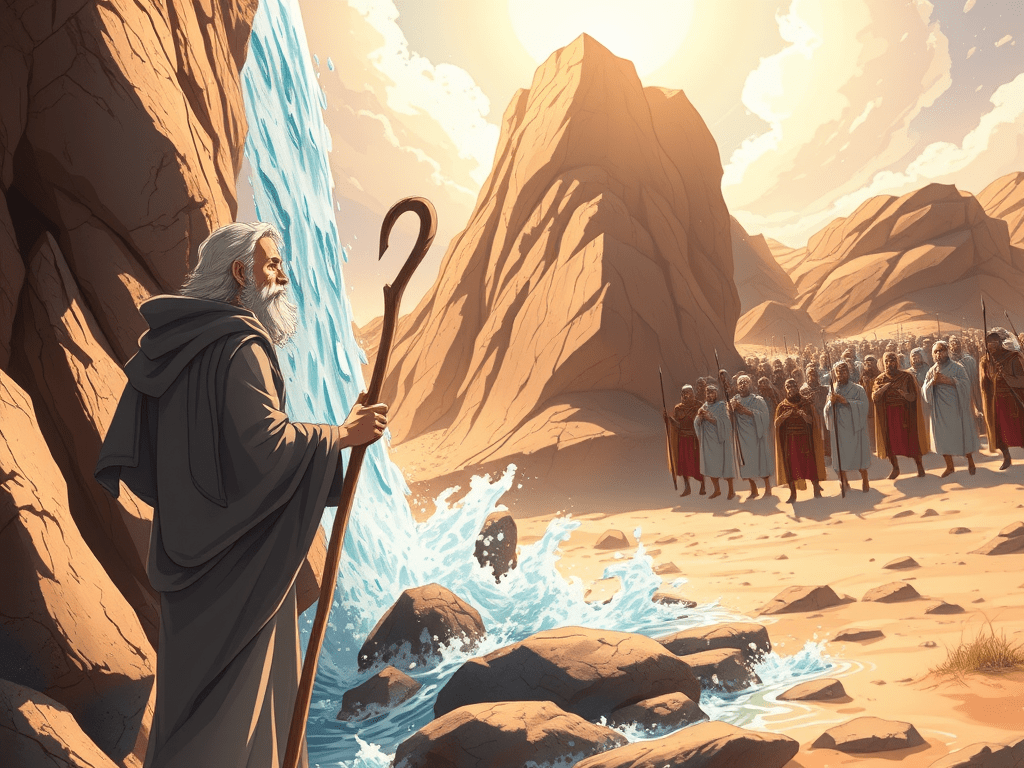
The apex of the Torah’s Leadership theme occurs with Moses caught in the Almighty’s crosshairs. The Portion Chukat concludes a three-part leadership masterclass. The trilogy includes the two preceding portions- Shelach and Korah. Those addressed a lower-level leadership crisis and a mid-level-leadership challenge respectively. The third masterclass installment addresses a chief executive fail. This post offers four takeaways.
The Chukat Story
The Children of Israel are once again complaining in the Portion Chukat. This time, there is the need for water.
To address this predicament, Moses and Aaron are tasked by the Lord.
“And the Lord spoke to Moses, saying, “Take the staff and assemble the congregation, you and Aaron, your brother. And you shall speak to the rock before their eyes, and it will give its water. So you shall bring water out of the rock for them and give a drink to the congregation and their cattle.” Numbers 20:8
The instruction was clear. Moses was to do some rock talk. [Note: Was this an attempt to “lower” the nation’ temperature?]
Moses, who had been under mounting pressure, disobeyed.
“And then Moses took the staff from in front of the Lord as He commanded him. And Moses and Aaron assembled the community opposite the rock. And he said to them, “Listen, rebels, shall we bring water out of this rock for you?” And Moses lifted his hand and struck the rock with his staff twice. And much water came out! ” Numbers: 20:11
Moses’ defiance was almost instantaneously rebuked.
“And the Lord said to Moses and to Aaron, Because you did not trust in me, to make me holy before the eyes of the children of Israel, therefore you shall not bring this community to the land that I have given them!” Numbers: 20:12
The Takeaways
Four leadership issues arise from Chukat. Social contagion’s impact on leaders, a leader’s shelf life, an executive’s termination, and the necessity of a succession plan.
Social Contagion
For the Children of Israel, the wilderness experience was toxic. Collective discontent can lead to a breakdown of order. They harbored behavioral, attitudinal and emotional deficits. These deficits eventually infected the leadership. Moses’ outburst reflected that the congregation impaired his judgment. As a result, he too became a rebel.
A Leader’s Shelf Life
The term “shelf live” refers to the reality that leaders have limited periods of effectiveness. With Moses, his age was impacting him. He became increasingly vulnerable to a leadership challenges. This factor is combined with the fact that Moses became unhinged. Clearly, Moses, and his ability to lead, had “jumped the shark.”
Your Services Are No Longer Needed
With ending organizational relationships, timing matters. Moses’ defiant act was a door of opportunity to terminate. His actions allowed upper management- the most upper of management, the Lord- an opportunity to make change. At the time, the Lord, may have appreciated that he needed to end the relationship to appoint a successor. A new task-the entrance to the Promised Land- was coming which may have required a new type of leader.
Succession Plan
Prior to the incident, there was another reality. There were future leaders in the wings. Joshua, Caleb and Eleazar, Aaron’s son to act as Priest were capable leaders. Without these replacements ready to go, it is unlikely that this divine termination would have been taken place.
Conclusion
On a secular basis, the Torah offers outstanding discourse on a variety of topics which include leadership. Chukat culminates a three-part masterclass on leadership which addresses the topic from top to bottom. It started with lower management’s failure with the Twelve Spies in Shelach. It continued with a middle management attempted power grab in Korah. It concluded in Chukat with a respected leader’s fail.
Be well!!
Please like, follow, comment or share
 The Ten Commandments Project
2 thoughts on “The Leadership Trilogy Ends With Four Takeaways: Chukat”