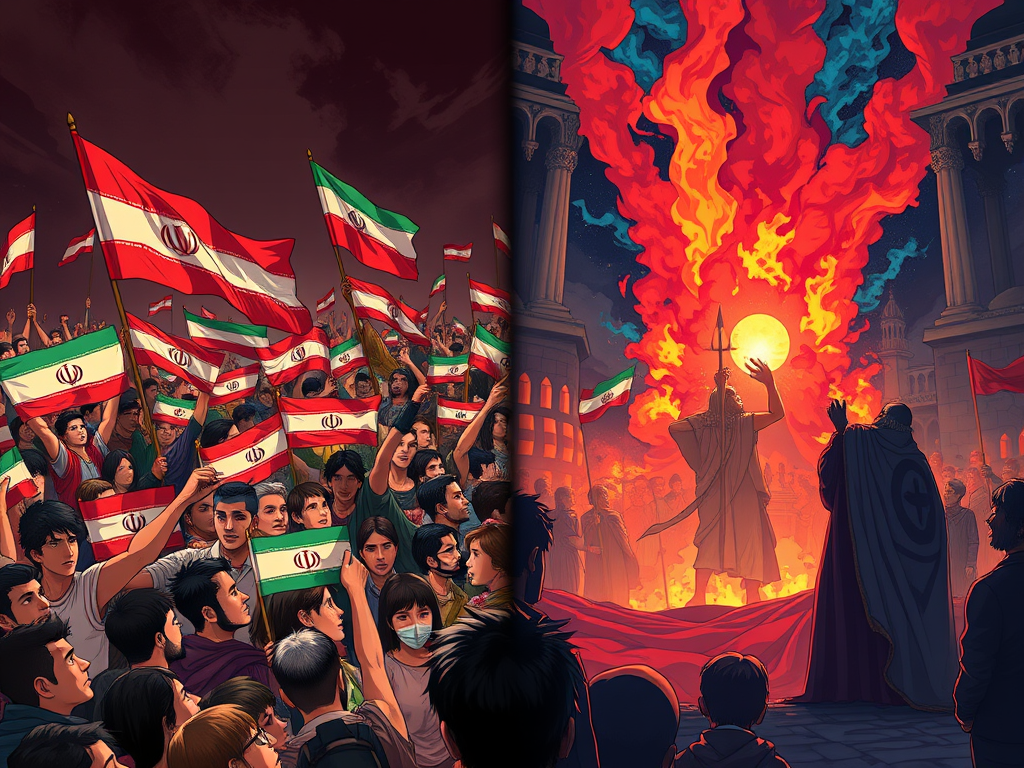
Posting on current events can often be futile. As many news items have limited shelf-life, a post’s utility evaporates rapidly. With the ongoing Iranian uprising, however, this is not the case. What is transpiring aptly connects into the political theories espoused by the Hebrew Bible.
Specifically, the Torah Portion Va’era touches on an ongoing conflict; one for which no resolution is in sight. Thus, comparing the Iranian people’s grievances to the Moses’ “let my people go” narrative can bring insight and understanding. We can see the past in the present and the present in past.
Modern Times
The Islamic Republic of Iran is currently in the throes of a people’s rebellion. As a result, their leader- the Ayatollah Ali Khamenei- is in an Exodus-like crisis. His leadership is being challenged on a daily basis.
Dissatisfaction over Iran’s poor economy and water shortage- among other matters, has led to nationwide protests. Additionally, religious observance orthodoxy issues have ignited popular upset.
The Comparison
The leadership crisis connected to ongoing public disruptions bare comparisons to the Torah Portion Va’era.
Va’era’s passage of interest tells of Moses’ demands upon the Pharaoh, the resultant plagues, and the Egyptian’s leader’s reaction. Va’era, however, leaves the reader without resolution.
In Va’era, Moses has instituted a rebellion of sorts involving religious freedom. He asked the Pharaoh for an allowance that the Children of Israel can go and worship their God. Exodus 8:1. With the Pharaoh considered as a “living god,” Moses’ request was most likely problematic. It likely interpreted not only as sacrilegious but also as seditious.
In Va’era, in an effort to exert religious freedom, plagues- disruptions of societal life- were initiated.
Arguably, the Iranian protests are symbolic of the plagues. They have involved destruction and attacks on national symbols occurred. They are societal disrupters. Further, symbolic displays striking at religion have occurred; some women are posting inflammatory pictures of them lighting up cigarettes.
In Va’era, each and every plague tested the Pharaoh’s resolve. Similarly, with Iran, each and every protest is testing the Supreme Leader’s resolve.
The Va’era Narrative
As the Exodus narrative ends in Va’era, there is the following passage: And Pharaoh saw that the shower and the hail and the thunder stopped, and he continued to sin, and he made his heart heavy, he and his servants. And Pharaoh’s heart was strong, and he did not let the Children of Israel go- as the Lord had spoken by Moses’ hand. Exodus 9:34-35.
Conclusion
The fact that the Iranian discord remains unresolved makes its connection to Va’era so strong. What is to be made of a matter when there is historical uncertainty? What will be come to the heart of Iran’s leadership? Will the unrest continue? What will be the end result?
Perhaps, this is why Biblical narratives are so important. Not only do they offer insight into events in progress, they also serve as inspiration for those seeking resolution. While the Iranian people in real time are confronting their national crisis, the Torah’s story, with further reading, is complete. We know- spoiler alert- that the people will eventually be “let go.”
Thus, as a national leader is currently struggles in his existential crisis, we sit and watch. All those involved are aware that the Torah’s narrative. All are aware that the past narrative ends with the people’s freedom.
Be well!!
Please like, follow, comment or share.
 The Ten Commandments Project
One thought on “The Tipping Point in Real Time: Va’era”