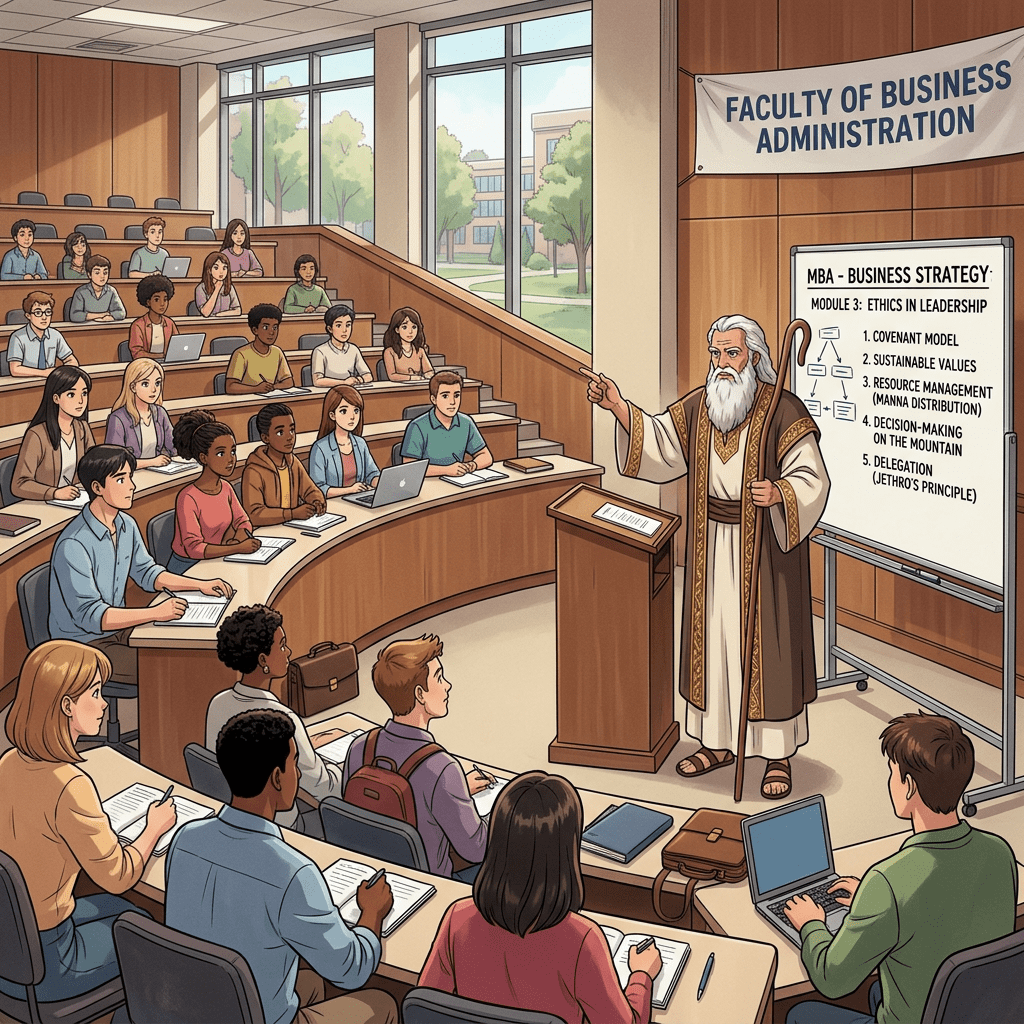
The Pentateuch’s Management Master Class includes the Torah Portion Chukat. With God’s post-Exodus Promised Land relocation plan in crisis, the Lord must make a hard pivot. The Portions Chukat- along with Shelach and Korah- document the Deity’s resetting of his fledgling Israelite nation.
Across these portions, problematic, stiff-necked and rebellious individuals plague the completion of God’s goal- the nation’s re-occupation of the land upon which their forefathers Abraham, Isaac and Jacob lived. While a massive staffing overhaul is required for a variety of reasons, God apparently valued his nation’s organization chart. God’s staffing overhaul, as played out, would be complete, from top to bottom.
To accomplish re-staffing, God employs a multitude of measures. Chukat is perhaps the most peak moment; he terminates his top executive officers- Moses and Aaron. This major move, however, must be appreciated in light of the earlier moves in the portions Shelach and Korah.
Shelach
The Portion Shelach’s scouting mission failure profoundly rocked the nation.
The initial plan was good; the Lord indicated that one man from each tribe was to go on the mission to scout Canaan; the Levites, however, were not included. Numbers 13:1-2. The chosen people were select; they were to be the heads of the Children of Israel. (Note: The Levites’ lack of land inheritance may have been the reason. Or, they, organizationally, were viewed as a separate entity from the Children of Israel.)
The scouts undermined the project by instilling the Israelites with lack of confidence in the likelihood of securing the Promised Land. Chaos errupted; all of the congregation of the Children of Israel faltered.
Moses was confronted by God because of their lack of faith. “And the Lord said to Moses, ‘How long will this people reject me, and how long will they not trust me…. I’ll strike them with an epidemic and dispossess them, and I’ll make you into a bigger and more powerful nation than they are.” Numbers 14: 11-12.
Moses, however, convinced the Lord to back down. For Moses sake, he saved the Israelites. However, he was to bar them from seeing the Promised Land. The exception would be Caleb because a different spirit was with him. Joshua as well would be an exception. Numbers 14:30.
With this, the Children of Israel were to be replaced by attrition; the passage of a generation- forty years- was the plan.
From this, the Children of Israel’s body had changed. The only two remaining possessed the desirable qualities required to complete the Promised Land goal.
In this crisis, it appears that the Levites remained separate from the Children of Israel.
The Levite crisis would occur in the Portion Korah.
Korah
The Portion Korah involved a mid-level management overhaul. Korah, a Levite, joined forces with some Israelites- from the Tribe of Reuben, to challenge those were to participate in cultic practices. This time it was not the entire congregation that was the challenge. Rather two hundred and fifty people of repute.
In the end Moses’ cunning, and his reliance upon the Lord allowed for him to quash the mid-level management. The rebellion was eliminated.
Later, to further quell this leadership matter, the Lord had each tribe place forward staffs. The Lord, through these staffs, essentially chose the Levites- Aaron’s staff. The staff was to be a sign for the rebels. Numbers 17:25. The Levites were to be the leaders. [Note: Was Aaron’s staff used as he was Moses’ elder brother?]
Arguably, other individuals would be filling these mid-level society position with the understanding- a sign from the Aaron’s staff- that the Levites were to be in charge of the cult.
In this instance, God trusted Moses to deal with the staffing elimination. Moses employed his skills to set up Korah and company for failure. The challenge assigned to them was going to fail. In the end, it was God who eliminated these individuals when they were sucked into the ground. In essence, playing with fire got them fired.
Despite Moses’ tremendous contribution to the Israelite national project, he would succumb to the pressures of leadership.
Chukat
In Chukat, there is a water supply crisis. God gives Moses specific instructions with respect to obtaining water. Numbers 20:8. Moses was instructed to speak to a rock. Instead, Moses, in an outburst, strikes the rock two times. As a result, water flows out.
As a result of Moses’ failure to follow instruction, God determined that Moses’ services were no longer going to be required. The Deity even provided his rationale: “And the Lord said to Moses and to Aaron ‘Because you did not trust in me, to make me holy before the eyes of the Children of Israel, therefore you shall not bring this community to the land that I have given to them!” Numbers 20:12.
While Moses and Aaron remain as trusted individual, God gives them notice as to their limited future role in the organization. To both Moses and Aaron’s credit, both of them accept the change in their roles. Likewise, God trusted them; he believed that he could trust them to complete their job.
Moses’ leadership, however, at the moment reflected poorly on God; he undermined authority; he acted unbecoming of top management; he was essentially burned out from the enormous pressures from the job. An additional theory would be that God may have anticipted that, given Moses’ age after the forty years wilderness wandering moving forward, would be too old to complete the job. [Note: Moses and Aaron’s sister, Miriam, had passed away before the rock incident. Thus, there was no need to address her ongoing role.]
At this point, God was prepared; his replacements were in line. Joshua, Caleb and Aaron’s sons would take the place of Moses and Aaron. In the interim, Moses and Aaron would be involved in the transition which included the attrition.
While Chukat resulted in history’s most well-known firing, God did not disrupt the nation’s organization.
The Organization
Despite the wholesale workforce change, the organizational structure remained intact. The leadership position was to remain in place- the Prophet- as well as the priesthood. The tribes were to remain in place. The addition was a sign-Aaron’s rod- which was to impress upon the tribe’s as to leadership designation.
With the organizational chart intact, the project will continue with substantial amounts of personnel change.
Conclusion
Over the course multiple portions, God essentially re-set his total workforce to his fledgling Israelite nation by employing various techniques: Chukat involved the lay-off of upper management- Moses and Aaron; the entire lower-level staffing was to be replaced by attrition per Shelach; and in the most unique of the management moves, God acted in concert with his trusted leader Moses to eliminate a mid-level management rebellion in Korah; this was accomplished by a set up.
In the end, God retained Joshua, Caleb, and the cultic Priests, and Levites, who would complete the Promised Land occupation mission. Replacement staffing was done; individuals with either special qualities or commitment were on board. The Israelites, on the other hand, were replaced with a new generation which was not strongly attached to the fanciful memories and myths of Egyptian life.
In sum, Israelite nation’s re-vamping involved a series of moves taken at varying times. In essence, personnel management is not a one size fits all affair.
Be well!!
Please like, follow, comment or share


One thought on “Chukat: The Pentateuch’s MBA Program”