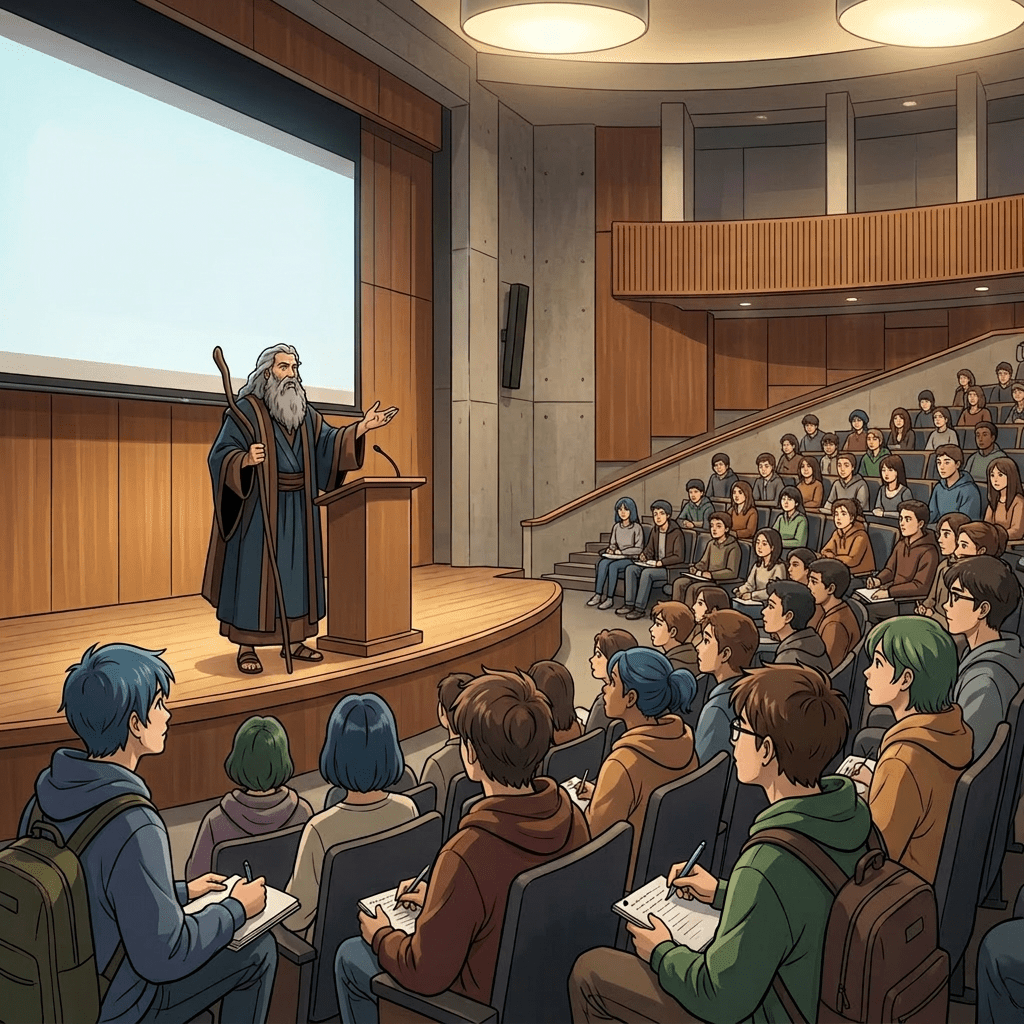
The Book of Deuteronomy begins with the Torah Portion D’varim. In D’varim, Moses begins his final speech on the other side of the Jordan River to all of Israel. Deuteronomy 1:1.
The Book of Deuteronomy stands out from the rest of the Pentateuch. Scholars and theologians focus often address Deuteronomy’s significance as either second law or the repetition of the law. There, however, was something else of important; the audience. Who was “all of Israel?”
The Portion D’varim begins Moses’ last speech. The answer to who was the speech’s audience is controversial. Who was it? There is a theological as well as a scholarship answer to that question. In the end, the question concerning the audience is “on which side of the Jordan did the audience hear Moses’ words?” Was this speech received in or outside of the Promised Land?
Audiences matter. Without a receptive audience, Moses’ brilliant speech would have fallen up deaf ears; it would not have had legs to march through history and theology to the present day. In essence, his audience, whoever it actually was, grasped the baton from Moses and have kept his words alive to present day.
In knowing the audience, one can also better understand Deuteronomy’s theology and politics.
The irony is that with either choice of audience- scriptural or scholarly, both answer yield a common feature: land.
To understand the audience from a scriptural standpoint, one must start in the Book of Genesis.
In the Beginning
The Book of Genesis provides an important clue as to the nature of Deuteronomy’s audience. Moses’ D’varim speech refers to knowledge of good and bad as far as his audience. Specifically, their lacking of the knowledge of good and bad. This matter of knowledge envelopes the story of Adam and Eve.
Genesis tells of the Garden of Eden’s fruit bearing Tree of Knowledge of Good and Bad. Genesis 2:8-3:19. Adam and Eve, despite being divinely instructed to not eat the fruit, broke the rule. They became conscious; they felt shame in being naked.
As a result of this act and now knowing good and bad, they were expelled from the Garden of Eden. In contrast, the Torah Portion D’varim reveals that Moses’ audience included people who did not know good and bad. These individuals would be the ones who were set to enter the Promised Land.
Since the Garden of Eden, Humanity changed. With respect to the Children of Israel, they received the Torah at Mt. Sinai. Thus, at the time of Moses’ speech, laws and instructions were available to the populace. This situation unlike Adam and Eve. They were without a Torah, and had limited instruction and direction. To be fruitful and multiply and to not eat the fruit from the specific tree were their two most memorable instructions.
Genesis creates and land-law connection. Fealty to the law is tied to one’s land occupancy. Disobedience can lead to expulsion. This concept was advanced within the Ten Commandments. The rationale for Honoring One’s Parents was “so that your days on the land that the Lord, your God, is giving you.” Exodus 20:12.
Beyond that, the product of the land- fruit- also connects the stories. In Deuteronomy, the audience will be told that when they are living in the land that they “shall take from the first of all the land’s fruit that you’ll bring in from your land that the Lord, your God, is giving you, and set it in a basket and go to the place that the Lord, your God, will choose to tent His name there.” Deuteronomy 26:2.
The instructions clearly created an understanding that the first produce created from the land was to go the creator; God. (Note: Was entitlement to first fruits a divine matter? Is it fair to allude to the fruit from the Tree of Knowledge of Good and Bad as a first fruit, one that was intended for a deity?)
The Scriptural Audience
Moses’ final address was to all of Israel; particularly, it was to those would be entering the Promised Land. Absent Joshua and Caleb, who were the exceptions, these listening would include “… infants whom you said would become a spoil, and your children today who haven’t known good and bad, they will come there, and I’ll give it [the Promised Land] to them, and they will possess it.” Deuteronomy 1:39.
There is some question as to how educated these individuals would have been. Not all those attending Moses’ final speech were present at Mt. Sinai when the Ten Commandments was received. One could argue that the re-telling of the law within Deuteronomy, for some, might have been their first opportunity to be fully versed.
The Land Connection
Thus, on a theological basis, on a scriptural basis, compliance with the laws is being connected to Promised Land residency. The land connection also is relevant concerning Deuteronomy’s other audience.
Some scholarship suggests that the Book of Deuteronomy, and Moses’ speech was something that was presented to a different audience at a different time. Both Rashi and Richard Elliott Friedman believe that this book was introduced at the time of King Josiah’s reform. Moshe Weinfeld, Deuteronomy scholar, has opined that book may have been crafted at the time of King Josiah.
The Other Audience
Scripture tells that during King Josiah’s reign, a book of the law was discovered by the High Priest Hilkiah. 2 Kings 22:8. King Josiah employed this book as a basis for a renewal of the covenant.
We are told “He went up to the temple of the Lord with the people of Judah, the inhabitants of Jerusalem, the priests and the prophets—all the people from the least to the greatest. He read in their hearing all the words of the Book of the Covenant, which had been found in the temple of the Lord. The king stood by the pillar and renewed the covenant in the presence of the Lord—to follow the Lord and keep his commands, statutes and decrees with all his heart and all his soul, thus confirming the words of the covenant written in this book. Then all the people pledged themselves to the covenant.” 2 Kings 23:1-3.
Give this, the audience to Moses’ speech may well have been Israelites living during the time of Josiah’s rule.
At the time of Josiah’s rule- 640-609 BCE-, the Northern Kingdom has already been conquered. As such, the Kingdom of Judah consisted of Judeans and refugees from the fallen Israeli state. So, arguably Moses’ speech’s audience was read to both Northern King exiles as the Judean populace. Thus, the audience was a mix of both those already expelled and those in fear of expulsion.
Thus, the audience had many existential questions. Was the Judean nation going to survive? And, was there anything that the populace could do to continue the nation’s good standing?
Thus, Deuteronomy’s message to the audience- regardless of which place in time- concerned itself with Promised Land residency. Specifically, how it was to be maintained.
The Land-Law Connection
In the end, a theological and political message emerges from Deuteronomy. It provides an answer to the audience of Moses’ speech. The question being: “How are we going to survive on our land?” The broad answer being: complying with the commandments.
This concept is not lost on modern states. People decry their countries are failing due to corruption. Some citizens of various countries maintain and belief of national purity; that the country is operating in a moral, just and fair manner. These citizens as well fear that if their countries do not hold themselves up to certain standards, they nation will fall. The Book of Deuteronomy arguably captures that train of thought.
Conclusion
While the Portion D’varim marks the beginning of both a political and theological shift within Israelite society, Deuteronomy’s contents are not fully appreciated without understanding the audience for Moses’ final speech.
Scripturally, the presentation was directed to those about to enter the Promised Land. Historically, the presentation was directed to those in danger of losing their land; their nation. Thus, theologically, Deuteronomy advanced the notion that one’s residency was tied into one’s commitment to the commandments. This is a central concept with Deuteronomistic thought. Even in the modern world, the concept remains accepted. Many people still tie their nation’s success to it being a just society.
Be well!!
Please like, follow, comment or share


2 thoughts on “Second Law, Second Audience: D’varim”