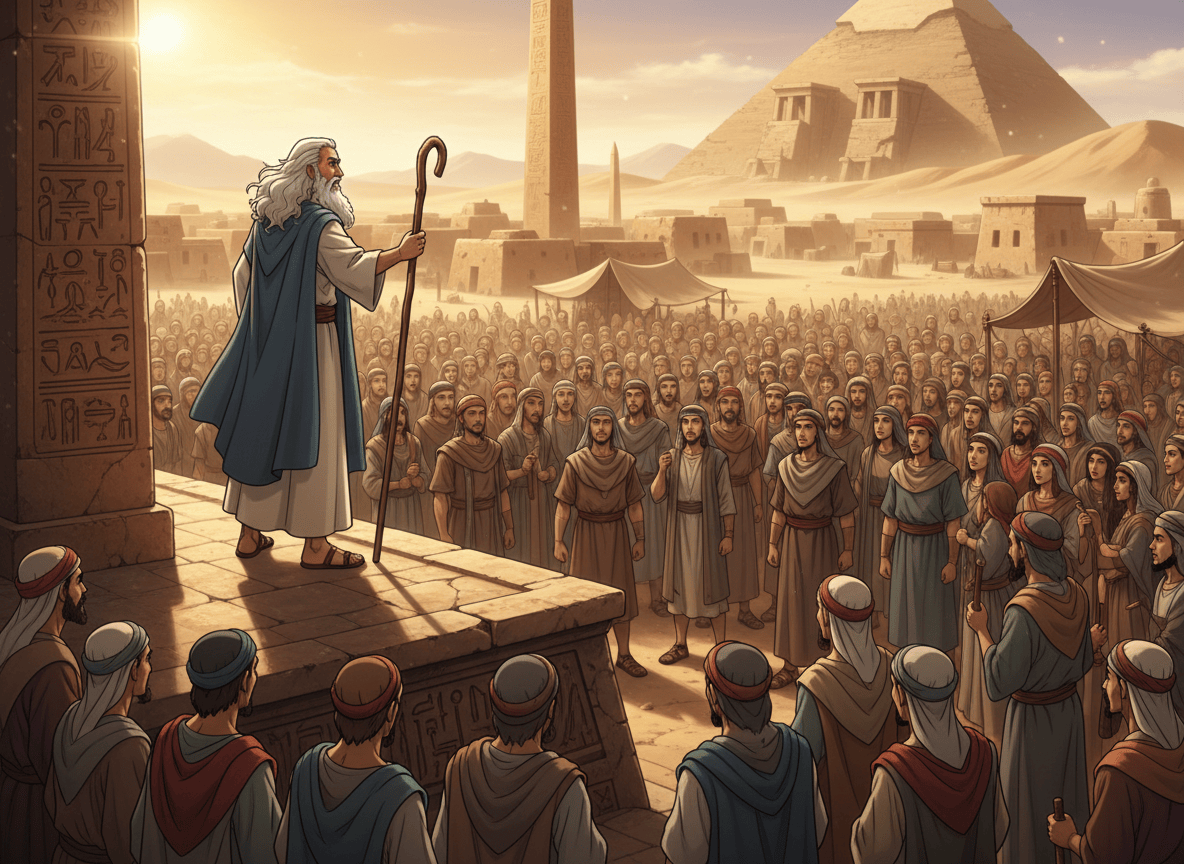
The Torah’s eternal wisdom comes from its structure. Spanning from the world’s creation to the formation of a nation, the Pentateuch’s narrative captures almost every possible relationship and the difficulties arising from them. In the Torah Portion Va’era, the leader-nation relationship is brought to the forefront. In the beginning of executing God’s plan to free the Children of Israel from their Egyptian Bondage, Moses experiences a leadership fail. Failures, such as this one, present as learning opportunities.
To appreciate the fail, some of the background must be told.
The Background Story
After Moses and Aaron arrived in Egypt to free the Children of Israel, the two met with the Israelite Elders. With the elders appearing to be on board with God’s objective, they then went on to meet with the Pharaoh.
Moses and Aaron’s meeting with the Pharaoh did not go well. Pharaoh responded to their demands by implementing harsh measures to make the Israelite laborers’ jobs more difficult. As a result, the Hebrews suffering increased.
After the meeting with Pharaoh, Moses complained to God about the trouble that was created as a result of his engagement. questioned his role in this mission.
In response to Moses, God provide him words to tell the people: “I am the Lord, and I shall bring you out from under Egypt’s burdens, and I shall rescue you from their toil, and I shall redeem you with an outstretched arm, and with tremendous judgments, and I shall take you to me as a people, and I shall become your God, and you’ll know that I am the Lord, your God, who is bringing you out from under Egypt’s burdens. And I shall bring you to the land that I raised my hand to give to Abraham to Isaac, to Jacob, and I shall give it to you as a possession. I am the Lord.” Exodus 6:8.
With these promising words to say, Moses went to meet with the Children of Israel.
Moses’ Fail
Upon meeting the Children of Israel, the Torah tells: “And Moses spoke this to the Children of Israel and they did not listen to Moses because of their shortage of spirit and because of hard work.” Exodus 6:9.
The Audience Matters
For leaders, great speeches full of promises can fail. In Va’era, Moses lacked a receptive audience. Audiences matter.
Writers, as well, are often told to focus on their audience’s needs. Just like readers, a political rally’s audience has needs. For leaders, a group of exhausted individuals lacking in enthusiasm was not conducive to make any favorable impression. It is akin to a writer dealing a reader’s tired eyes and their lack of motivation to crack open the book. In sum, a leader addressing a physically and emotionally weary crowd is likely doomed.
In essence, leaders must be mindful of their audience’s needs.
Conclusion
While leaders can possess speech full of wonderful promises, such an address can still fail. Leaders are like writers; their audiences matter. William Zinsser speaks of treating the audience as another process in the creative act of writing. See On Writing Well at Page 27. The same is with speech writing. Readers and followers’ attention spans help to solidify the communicator-recipient relationship. In Va’era, Moses’ audience, due to their fatigue and loss of spirit, were not going to be receptive to any message. Their listening capacity was cognitively compromised by both fatigue and emotional collapse. In sum, Moses’ fail reveals that a leader’s communication is as much about its reception as its transmission.
Be well!!
Please like, follow, comment and share


One thought on “An Eternal Leadership Lesson: Va’era”