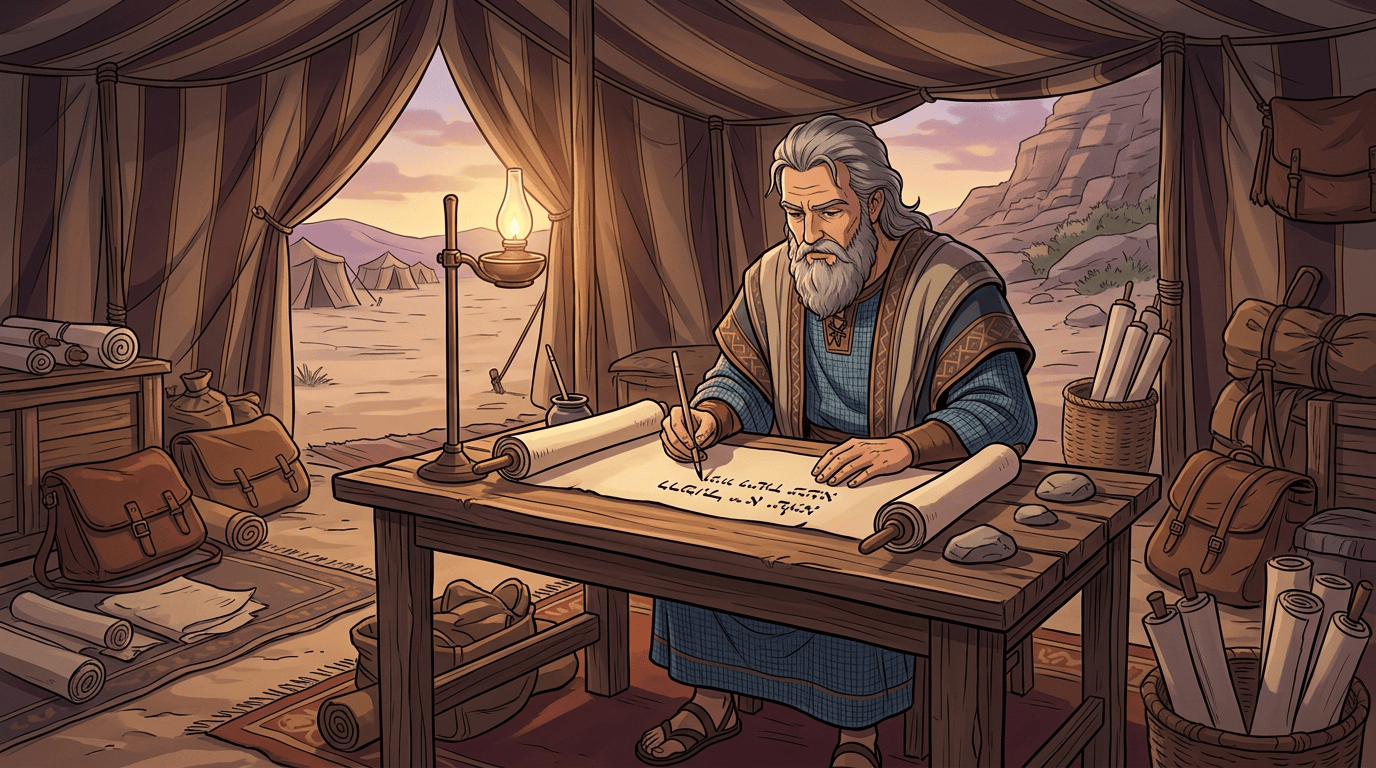
An Israelite historical milestone is reached in the Torah Portion Beshelach’s narrative. The portion introduces the Israelite’s first official writing. The Decalogue was not the first writing. Rather, before the Ten Commandments’ two stone tablets were inscribed by God’s finger at Mt. Sinai, the Israelites began recording their history.
To understand the change in the communication form, the act of writing must be addressed. Writing is an unnatural act. While animals and plants possess the ability to communicate, it is only humans that are capable of reducing their language into written form. Writing is tied to revolution. Beyond transforming how people both live and engage with others, writing also plays a role in nation building.
The timing of the Israelite’s introduction of writing in the Pentateuch narrative is significant. Likewise, the writing surface will also be significant.
Israelite Writing’s Significance
The writing’s significance noted within Beshelach is not that of innovation. The Children of Israel’s Patriarch Abraham came from Mesopotamia that had a history of writing. Rather, the Pentateuch narrative is recording when writing was introduced into the Israelite society.
Thus, Beshelach’s narrative leads to the question: “why, at that time, did the Children of Israel require writings?”
In order to get to that question, some of the Portion’s background must be discussed.
The Rules of Manna
After the Children of Israel were saved from the Egyptians as a result of the parting of the Red Sea, God begins to provide the Israelites manna to eat. God provided instructions concerning its distribution; he said to Moses: “Here, I’m raining bread from the skies for you, and let the people go out and gather the daily ration in its day in order that I can test them: will they go by my instruction or not. And it will be that on the sixth day they’ll prepare what they bring in, and it will be twice as much as they’ll gather on regular days.” Exodus 16:4-5. The seventh day- the Sabbath- would be a time not to gather. Exodus 16:23-26.
In Beshelach, while oral communication appeared to be the preferred mode of communication for the Children of Israel and their God, it had questionable effectiveness. Despite the Lord being quite explicit as to what he was saying: “If you’ll listen to the voice of the Lord, your God, and you’ll do what is right in his eyes and turn your ear to His commandments and observe all His laws….” Exodus 15:26, it did not take hold. Oral instruction, as noted in Behelach, was not followed. Exodus 16:20.
The portion then tells about a conflict between the Children of Israel and Amalek.
Amalek In Memorium
Beshelach’s last part tells of a battle between Amalek and Israel. Exodus 17:8. At the conflict’s culmination, it is said: And the Lord said to Moses, ‘Write this-a memorial- in a scroll and set it in Joshua’s ears…'” Exodus 17:14.
Arguably, this passage records the Israelite nation’s first writing. Commentator Moses Ibn Ezra opined that this writing may be part of a book the Torah referenced- The Scroll of the Wars of the Lord. The scroll is cited as a Torah within the Torah. See Numbers 21:14. (Friedman notes that the Torah indicates that there were known older written sources which it sometimes used or cited. Commentary on the Torah (Friedman), at P. 500.)
In the Beshelach passage, the reason for the writing was that the Lord was to “wipe out the memory of Amalek from under the skies!” Exodus 17:14. The rationale is puzzling. It gives rise to speculation: Was it because Amalek was eliminated and that the writing would evidence the battle? Or, was it recorded so that others would know that the Israelites fought and defeated Amalek? Either way, the conflict’s importance necessitated something requiring greater effectiveness of maintaining the information within the collective population. Passing the history from generation to generation was not perceived as proficient. In the Hebrew Bible’s last book, it was the Persian King who kept a historical record of his reign. See Esther 2:23; 6:1.
The takeaway is that, for the purposes of national standing, there was the necessity to reduce information into writings. In antiquity, governments maintained annals or chronicles.
The Big Picture Takeaway
Looking at Beshelach in isolation, the first Israelite book was their nation’s history. The history book, as was noted in the Book of Numbers, was a reference source used to craft the Torah. As also noted, governments maintained a history as part of their regime.
Taking Beshelach not in isolation, the portion is the beginning of the Israelite national library. Beyond the nation’s history being recorded in a written fashion, there would be other aspects of the Israelite governance that would also require writing. Thus, shortly after this portion, the narrative will move to the Israelite’s constitution (covenant) and laws would take the form of writing; the Ten Commandments.
With the Ten Commandments, both the writing surface and the scribe are also significant; there is a departure from Beshelach. Exodus 24:12 notes that Moses was instructed to “come up to me, to the mountain, and be there, and I’ll give you stone tablets and the instruction and the commandment that I’ve written to instruct them.” Eventually, the Torah tells that when God finished speaking with Moses at Mt. Sinai, “He gave the two tablets of the Testimony of Moses, tablets of stone, written by the finger of God.” Exodus 31:18. Impliedly, the Decalogue was more valuable component of the Israelite writings; it was divine!
Conclusion
In Beshelach, the Israelite written narrative begins with a written history. The particular first writing is possibly part of The Scroll of the Wars of the Lord; a book lost in antiquity which is also referred to as The Book of the Wars of the Lord. This scholarly opinion as to this position is buttressed by the fact that the scroll served as a Torah reference source. With the Beshelach writing, the national history was not only established but it was placed in the form of a scroll. The purpose at the time was perhaps the heightened need for the events to be remembered or have a reference. In fact, in the Book of Esther, the annals were read to the King. The further takeaway from Beshelach was the growing problem that oral transmission of divine matters lacked effectiveness. Shortly after Beshelach, the divine transmission of the Ten Commandments would be reduced into writing. They would be divinely inscribed into stone tablets.
Be well!!
Please like, follow, comment or share.

