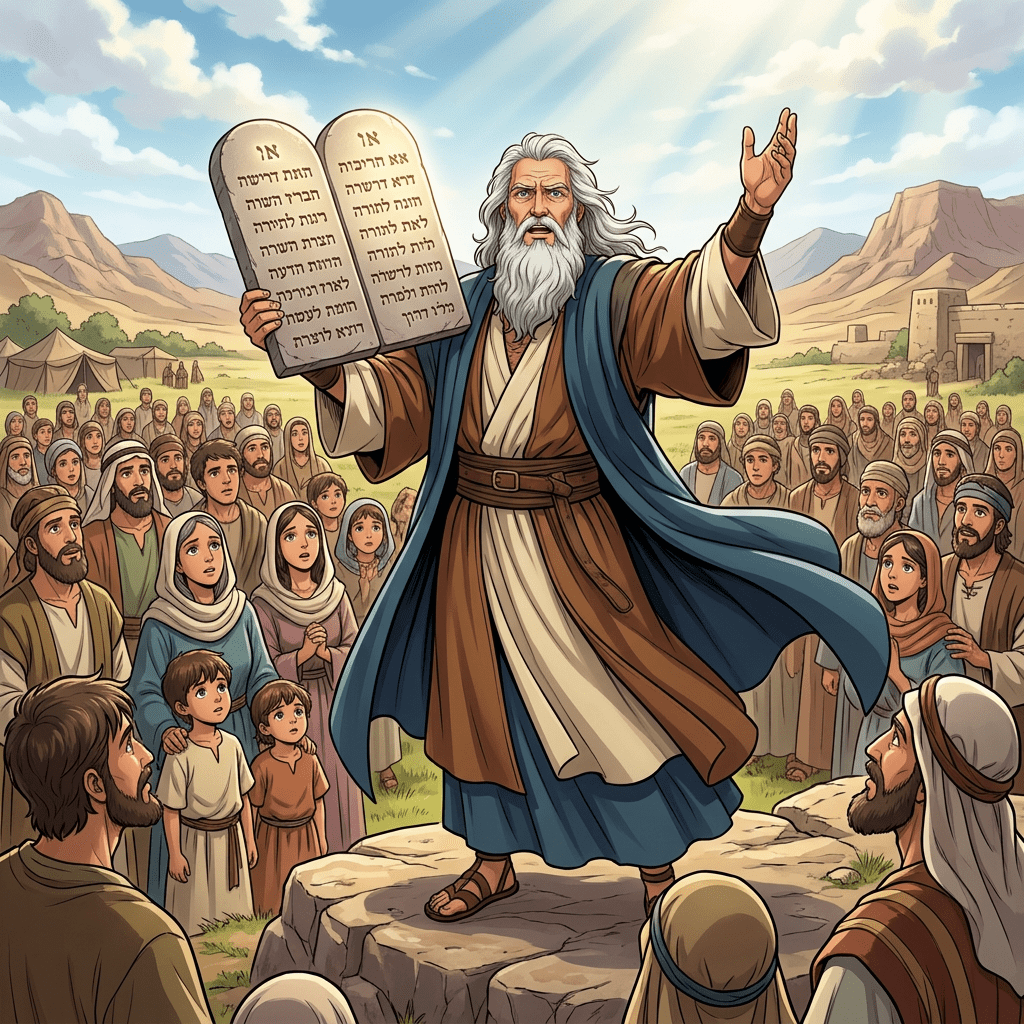
Lawmakers often provide a write-up when enacting a new law. These introductions can include anything from a legislative history to an explanation of the bill’s intent. In the Torah Portion Va’etchanan, Moses introduces the Ten Commandments to all of Israel. In doing so, he imparts essential information for grasping the biblical understanding of the Decalogue.
Albeit Moses’ words were not part of the original Mt. Sinai Decalogue pronouncement, his Deuteronomy statements provide a refined understanding of the Commandments. Specifically, Moses explains to his biblical audience the Decalogue’s particular meaning and responsibilities. With it, the politics, theology and responsibility surrounding the covenant are revealed.
Moses’ Introduction
Prior to Ten Commandments’ retelling in Va’etchanan, Moses provides his audience the following introduction:
“Listen, Israel to the laws and the judgments that I’m speaking in your ears today. And you shall learn them and be watchful to do them. The Lord, our God, had made a covenant with us at Horeb [Mt. Sinai.] The Lord did not make this covenant with our fathers, but with us! We! Living! Face-to-face, the Lord spoke with you at the mountain inside the fire….” Deuteronomy 5:1-5.
Moses’ explanation lays out the roles and the responsibilities of those subject to the Commandments. The introduction can be broken into two parts: the covenant and the covenantor’s responsibilities.
To understand the Decalogue covenant, one must understand the earlier Pentateuch accords.
Of Covenants Past
Prior to the Ten Commandments, the Torah reflects two major covenants: Noahide and Abrahamic. With each covenant, besides God, there were specific partners.
In the Noahide covenant, Genesis indicate that the parties were as follows: “And God said to Noah and his sons with him, saying “And I: here, I’m establishing my covenant with you and with your seed after you, of the birds, of the domestic animals, and of all the wild animals of the earth with you, from all those coming out of the ark to every living thing on the earth.” Genesis 9:8-10.
With the Abrahamic covenant, there is the following Genesis passage: “And Abram fell on his face, and God spoke to him, saying “I: here, my covenant is with you, and you’ll become a father of a mass of nations…And I’ll establish my covenant between me and you and your seed after you. And I’ll give you and your seed after you the land where you’re residing, all of the land of Canaan, as an eternal possession, and I’ll become a God to them.” Genesis 17:1-8
Abraham’s covenant continued through his son, Isaac.
Isaac’s covenant encounter was as follows: “And the Lord appeared to him and said, “Don’t go down to Egypt. Reside in the land that I say to you. Stay on this land, and I’ll be with you and bless you, for I’ll give all these lands to you and your seed, and I’ll uphold the oath that I swore to Abraham, your father…” Genesis 26:2-3.
Isaac’s son Jacob would then follow within the Abrahamic covenant.
The Book of Genesis notes Jacob’s encounter with the Lord. In that moment God spoke the following: “I am the Lord, your father Abraham’s God and Isaac’s God. The land on which you’re lying: I’ll give it to you and to your seed….And here I am with you, I’ll watch over you everywhere you’ll go, and I’ll bring you back to this land, for I won’t leave you until I’ve done what I’ve spoken to you.” Genesis 28:13-15.
The Decalogue’s covenant is a departure from the Abrahamic. Moses specifically points to that fact: “The Lord did not make this covenant with our fathers, but with us! We! Living! Face-to-face.” Mt. Sinai was not about Patriarchs or Matriarchs. Rather, it was about the nation of Israel.
While the covenant is expansive, it remained restrictive; it was directed to a specific group of people as opposed to the world in entirety.
The Extra-Covenantal Responsibilities: Laws, Listen, Learn & Guard
Beyond the covenant’s theological aspects, Moses provided directions; there was a need for knowledge of the law.
In essence, there was an expectation that the Israelites would know the law. They would know the law from listening to the law. Listening to the law impliedly meant to learn the law. In essence, they had to memorize and have the knowledge to be able to act in accordance with the law. Further, Moses’ statement implied all of the laws that were provided on the particular day as opposed to exclusively the Decalogue.
Further, there was an expectation that they would guard the law. An example of guarding the law occurred when the Children of Israel found a man collecting wood on the Sabbath day. The individual was brought to Moses and Aaron and the entire congregation. See Numbers 15:32-33. In modernity, there is the hebrew term “shomer” lends itself to both observance and guarding of a commandment.
Finally, this particular passage is important for what is not said. Given that there was no instruction for the audience to read or write the laws, one can assume that this was a period of limited literacy for the general population.
This notion is buttressed by the fact that their obligations differed from any future Israelite monarch. In Deuteronomy, the king was commanded to be literate: “And it will be, when he sits on his kingdom’s throne, that he shall write himself a copy of this instruction on a scroll from in front of the Levite priests. And it shall be with him, and he shall read it all the days of his life. Deuteronomy 17:18-19.
Conclusion
In the Torah Portion Va’etchanan passage, Moses’ introduction to the Ten Commandments extolls essential information to understand the biblical meaning of the Ten Commandments. From the passage, Moses delineated the expectations of the audience receiving the Ten Commandments.
The audience- Israelites prior to their crossing into the Promised Land- understood that the Decalogue’s covenant was a departure from past accords. They, as a people, were partners in the covenant as opposed to prior covenants of the Patriarchs and Matriarchs. Likewise, the Decalogue was a directed national covenant as opposed to an all encompassing worldwide covenant, i.e. the Noahide.
For responsibilities, the Israelites were instructed to the need to listen, to learn, and to guard the Commandments. These responsibilities reveal that the time was one of limited literacy among the general populations. Otherwise, Moses’ instructions would have referenced books, reading and writing as part of the educational process.
As such, the Va’etchanan’s passage enhances our biblical understanding of the Ten Commandments itself. With the fall of the Judean Kingdom, and with that the complete collapse of Israelite Kingdoms, the Ten Commandments’ meaning on both a theological and political basis arguably changed.
Be well!!
Please like, follow, comment or share
Note: Scripture and scholarship indicate three likely audiences for Moses’ introduction: Israel of the Torah the Israelite Kingdom with the reading of the Book of the Covenant at the time of Josiah, and the Judeans when Ezra read the Torah upon return from exile.


2 thoughts on “The Introduction to The Ten Commandments: Va’etchanan”